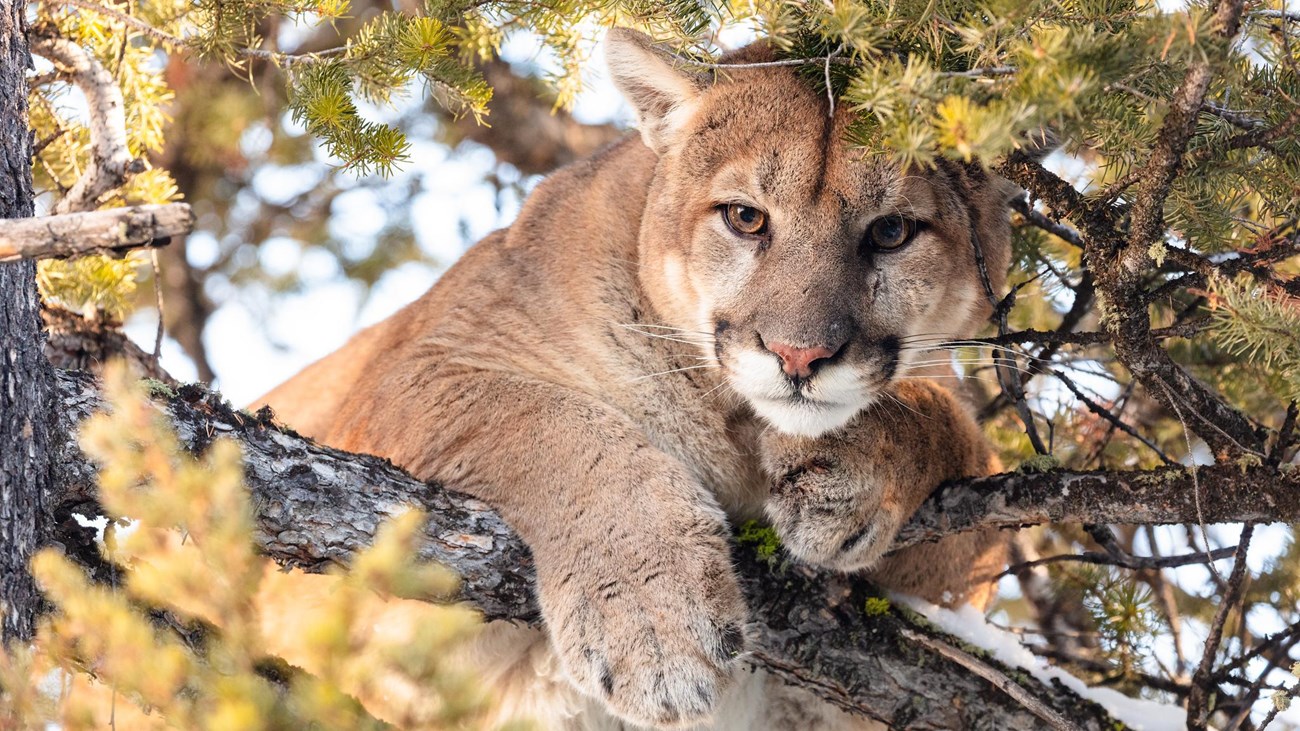
Today, we look inland at our mountains and forests where top predators like cougars remind us that nature is still wild and — often — unpredictable. PSI staff writer Eric Wagner has this look at a new paper with insights into when, where and why cougars may be more likely to cross paths with humans and what this might mean for the protection of both species.
Last July, a mountain lion attacked a four-year-old child who was hiking on a popular trail in Olympic National Park. The child’s father managed to fight the mountain lion off, and the child was airlifted to a hospital in Seattle, where they were treated and then released. The mountain lion did not fare as well. Within hours of the attack, National Park Service personnel had used canine teams to track it down, before they killed it the next morning.
The attack was covered across a wide range of regional and national media, and shortly after news publications throughout the state published a number of articles on the best ways to manage mountain lion-human interactions. “What Should I Do If I See A Mountain Lion On A Washington Hike? Follow These Tips,” read one headline in the Tacoma News Tribune. It was hardly the first time mountain lions and people had crossed paths in the national park, to say nothing of the Olympic Peninsula. Two years before, also in the park, a mountain lion had attacked another child, this one eight years old, this time causing minor injuries.
Mountain lions and people have seemed to run into each other much more frequently as the latter spend increasing amounts of time rambling about the habitat of the former. In their shared outdoor landscapes, conflict is seemingly inevitable. But a recent study in Ecological Applications drew from years-long tracking efforts on the part of Indigenous tribes on the peninsula to refine that message. By overlaying mountain lion movements with habitat type and different elements of the cats’ behaviors, Justin Suraci, a biologist with Conservation Science Partners in California, was able to show that certain characteristics of both landscapes and mountain lions can increase the likelihood of mountain lion-human interactions.
Elusive though they may be, mountain lions on the Olympic peninsula have been closely monitored for a long time. Working with the non-profit organization Panthera, tribal biologists from the Lower Elwha Klallam, the Point No Point Treaty Council, the Skokomish, the Quinault, the Makah, and the Port Gamble S’Klallam tribes have been affixing mountain lions with GPS collars since 2017, generating a wealth of tracking data.
Using the data from 72 collared mountain lions, Suraci first classified the animals by sex and whether they were feeding on native prey, such as deer or elk, or moving, which is to say dispersing to a new territory or defending an established one. He then analyzed the amount of time they spent in developed landscapes, working landscapes, and wildlands across the whole of the Olympic peninsula.
What Suraci found surprised him. “One of our early hypotheses was that encounters would correlate with mountain lions moving around the landscape,” he says. The thinking was that the more the big cats would move, the more likely they would be to run into people. Mountain lions and humans, for example, tend to like the same hiking trails, as has been seen. One might also typically expect younger animals that are dispersing across the landscape to be more likely to encounter humans. Instead, the data showed the opposite: mountain lions that were feeding and staying put were more often spotted by people. “Pumas are more likely to avoid human stuff when they’re moving around the landscape,” he says. “They stick more to natural habitats, versus when they’re feeding, when they’re less sensitive, or less avoidant of places adjacent to things like agriculture.”
Suraci and his coauthors reasoned that when hunting, mountain lions prefer to work along habitat edges, lurking, for example, just behind the tree line so they can stalk deer that are browsing in more open habitats. These more open habitats often happen either to be or to overlap with cleared areas for agriculture. The result, Suraci found, is that mountain lion habitat selection when they’re feeding tends to be where incidents with livestock or pet attacks are reported.
“It could be that once they have caught something they might spend hours or even days at the kill site,” he says. “And that increases the likelihood of them being seen or getting in conflict with livestock or pets.”
Suraci and his coauthors are using their results to identify habitats that are useful for mountain lions when they are both moving and feeding. “We’re trying to think about coexistence between pumas and humans,” he says, “rather than humans dealing with pumas in a day-to-day way. So it gives us a target for outreach campaigns to mitigate human-livestock-puma conflict.”
Read a summary of the cougar study in the Encyclopedia of Puget Sound.