
How can nutrients be managed to support healthy marine life in Puget Sound?
Our region is navigating complex decisions on how best to manage nutrients, including nitrogen and organic carbon, to maintain healthy habitats. Additional nutrients from human activities can potentially increase harmful algal blooms, decrease dissolved oxygen, compound ocean acidification, and cause other changes that may harm marine life. Water quality standards are particularly focused on the impacts that nitrogen from human sources has on low dissolved oxygen in Puget Sound. The nutrient management decisions we make now have the potential to shape the future of wastewater treatment, water quality, and our communities for decades to come.
Check out a refined tool that quantifies the impact of changing oxygen and temperature on Puget Sound marine life
Read the
summary
and
report.
What are you looking for?
New to nutrients and dissolved oxygen?
Start with a plain-language overview of how nutrients, dissolved oxygen, marine life, and management decisions are connected in Puget Sound.
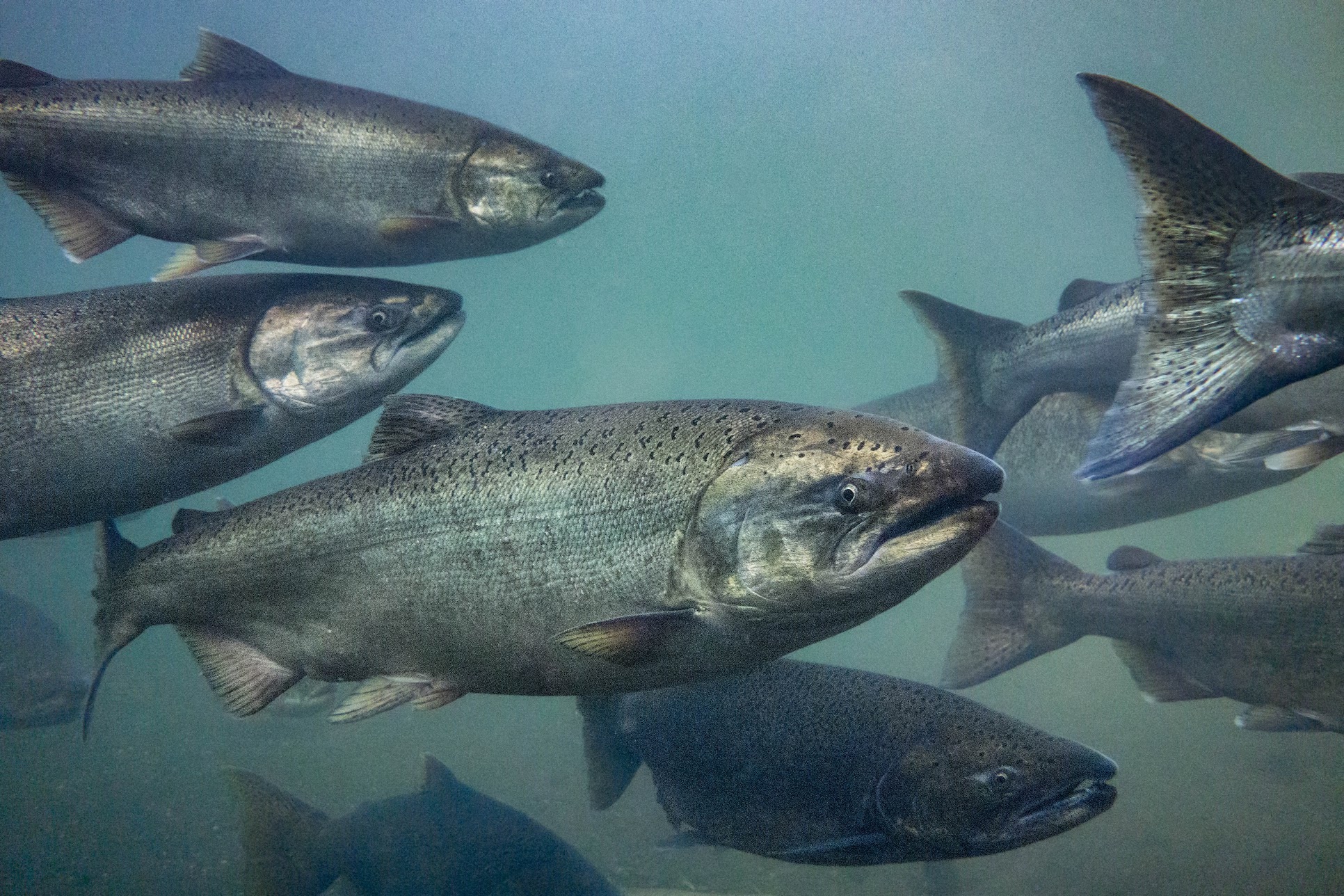
How does dissolved oxygen affect marine life?
Learn where low oxygen may pose risks to marine life and why oxygen and temperature should be considered together. UW Puget Sound Institute and the School of Aquatic and Fishery Sciences refined a tool to evaluate aerobic habitat compression.

Where does nitrogen come from?
See how much nitrogen comes from ocean input, wastewater treatment plants, and watershed sources — and what research from the workshops that Puget Sound Insitute convened suggests about how these inputs, productivity, and phytoplankton communities may be changing.

How are models informing nutrient management?
Understand how monitoring data and the Salish Sea Model informat nutrient-reduction targets. Puget Sound Institute has added to broader model evaluations by covening an international Model Evaluation Group and suggestions.

What do additional management scenarios show?
Puget Sound Institute is running the Salish Sea Model to test additional nitrogen-reduction scenarios and explore how different management choices may affect dissolved oxygen in sensitive areas.
Want to learn more?
Puget Sound Institute brought together regional researchers, modelers, agencies, Tribal scientists, and stakeholders to share research, build a shared understanding, and advance the science through workshops and scientific journalism.
How does dissolved oxygen affect marine life?
Sound-wide oxygen levels are generally healthy, but do changes in Hood Canal and embayments pose a risk to marine life?
Regulation is particularly focused on the impacts that nutrients from human sources has on low dissolved oxygen in Puget Sound. A few key scientific insights help ground these management discussions:
- The right combination of sunlight and nitrogen can cause algal blooms. Algae support the base of the food web, but when they die and decompose, they can cause low dissolved oxygen.
- While most of Puget Sound has sufficient levels of dissolved oxygen throughout the year, low dissolved oxygen occurs naturally in some places.1
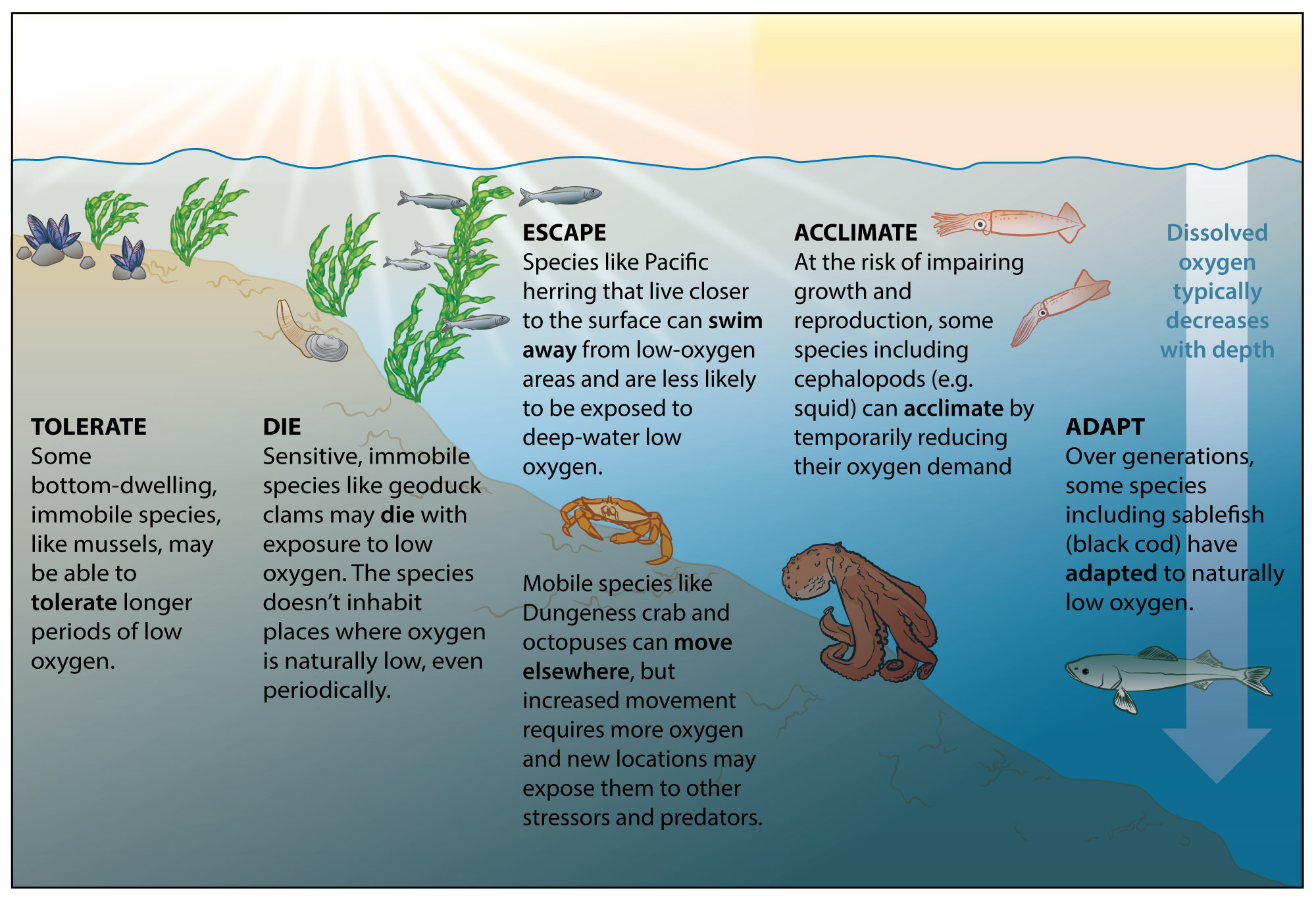
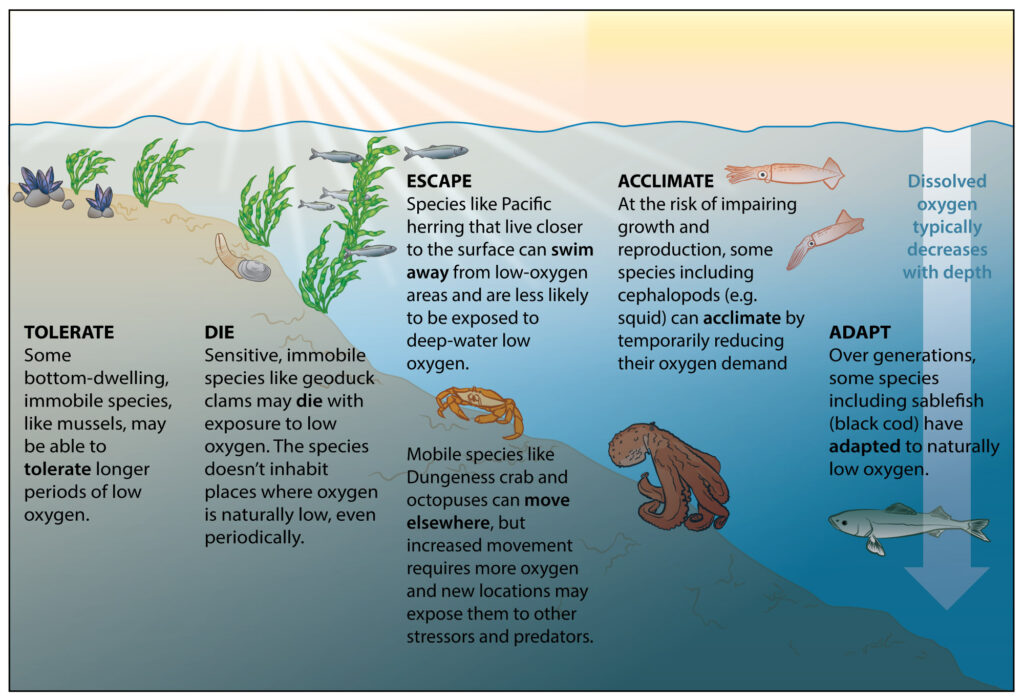
- Not all oxygen declines are necessarily harmful. Marine life may escape, acclimate, or adapt to mild drops in oxygen, but more severe or prolonged exposures may lead to stress or death.
- Although just 9% of the nitrogen in Puget Sound comes from human sources, modeling suggests it can worsen low oxygen conditions, particularly in Hood Canal and some shallow embayments.1
A refined tool to quantify the impact of changing oxygen and temperature on Puget Sound marine life
To meaningfully inform nutrient management, we need to understand not just when and where human-driven nutrients worsen oxygen conditions, but where those conditions may harm marine life. Previous efforts have evaluated when and where nutrients from human activities decrease dissolved oxygen levels. This research builds on those efforts to:
- Account for species-specific habitat use and oxygen thresholds, which can also improve traditional dissolved oxygen analyses by providing a clearer picture of where oxygen levels may affect marine life.
- Consider the combined effects of warming waters from climate change and reduced oxygen associated with nutrients from human activities. Because warming can reduce oxygen availability and increase species’ oxygen need, temperature and oxygen need to be considered together. In the Chesapeake, for example, rising temperatures offset 6-34% of nitrogen reductions achieved over the past 40 years.2
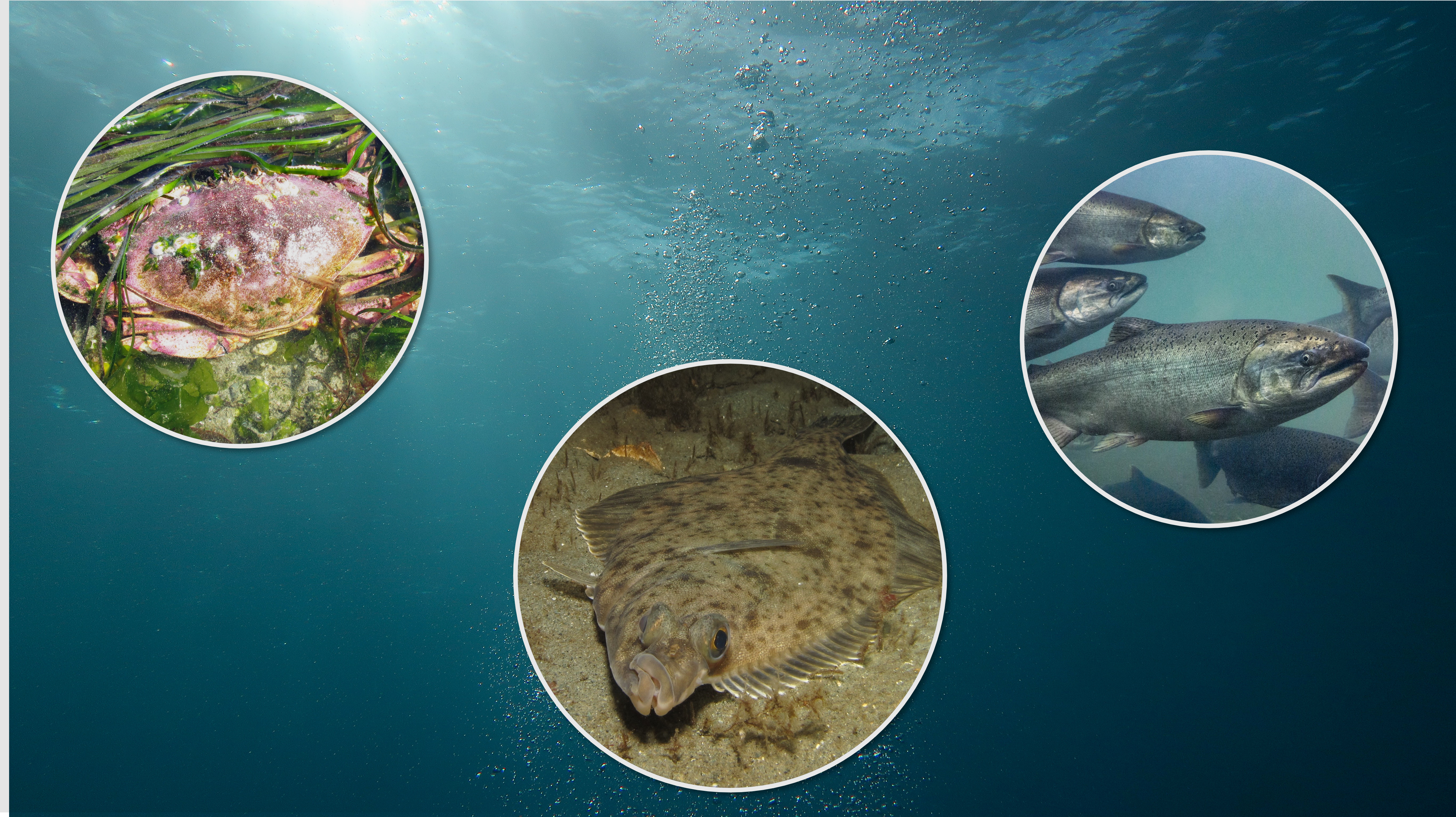
Inspired by research Martha Sutula presented at our first workshop, scientists at the University of Washington’s Puget Sound Institute and School of Aquatic and Fishery Sciences applied an established framework to evaluate aerobic habitat compression for Dungeness crab, English sole, and Chinook salmon. The analysis integrated species-specific oxygen thresholds3, applying them to model outputs from the Salish Sea Model. Explore the findings either through a short summary, the full report, or our most recent workshop.
Monitoring reinforces the importance of temperature
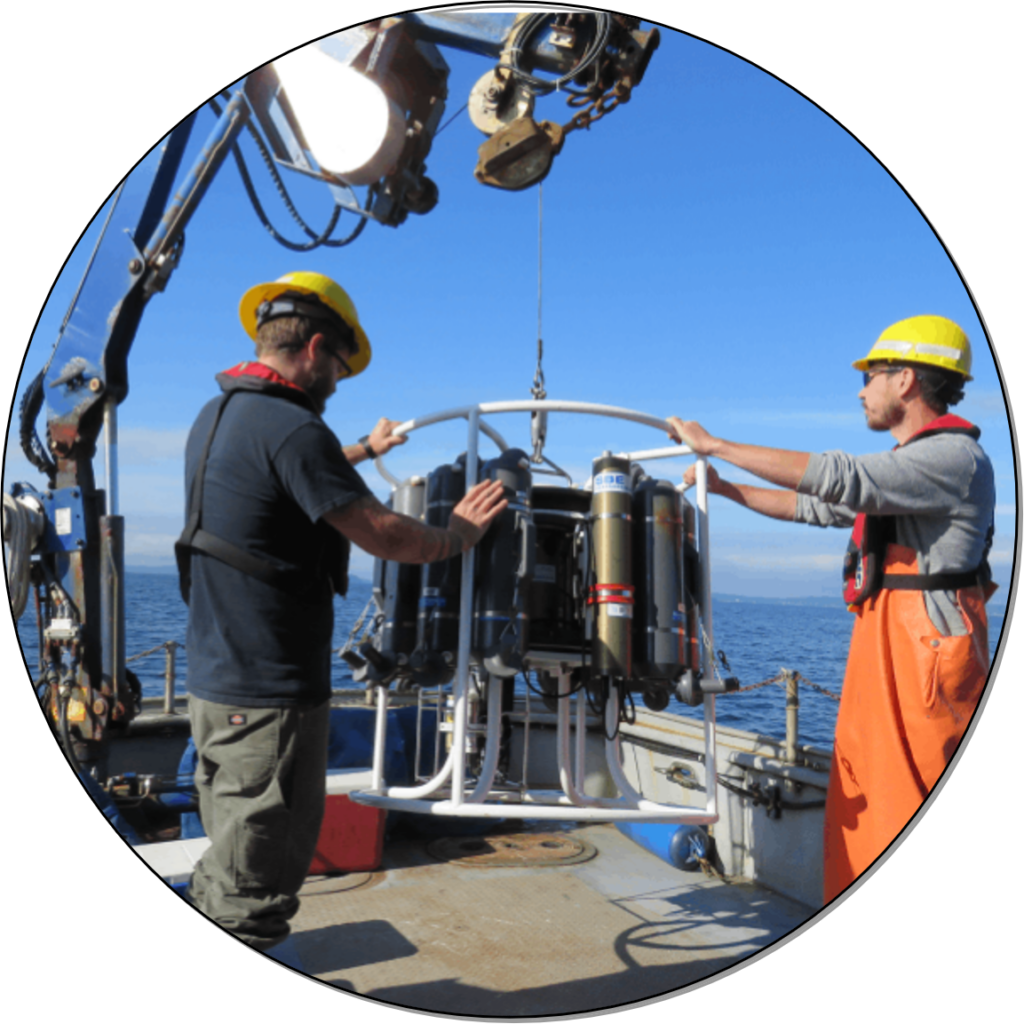
University of Washington researchers analyzed more than 12,000 shipboard measurements and identified five sites with sufficient data to track century-scale trends. Over the past century, warming caused most of the 0.3–0.9 mg/L decline in fall, bottom-water oxygen at these long-term monitoring sites in Puget Sound – near Seattle, Point Jefferson, and Carr Inlet.4
Where does nitrogen come from?
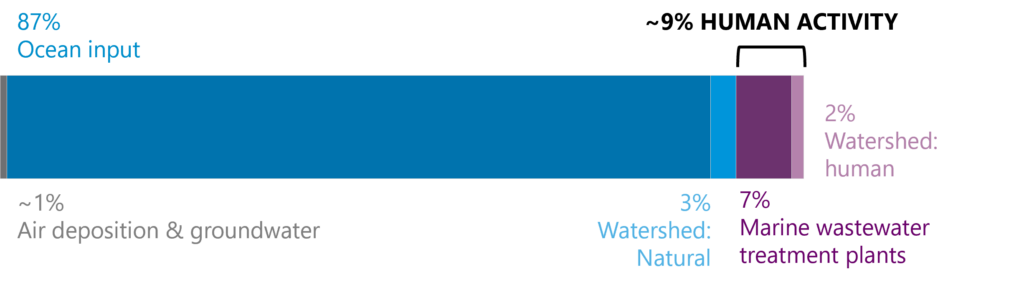
Most nitrogen entering Puget Sound comes from ocean input. Although just 9% of the nitrogen in Puget Sound comes from human sources, modeling suggests it can worsen low oxygen conditions, particularly in Hood Canal and some shallow embayments.1 Local sources of nitrogen are also the sources most directly affected by management decisions.
Check out the Encylopedia of Puget Sound for additional information on nutrient sources and the underlying data.
How are nitrogen sources changing?
-
- About 2% of nitrogen inputs are from watershed sources such as agriculture, stormwater, and other diffuse human activities.
-
- Research by Dr. Gordon Holtgrieve and Elizabeth Elmstrom found that δ¹⁵N ratios in the Deschutes and Nooksack Rivers indicate anthropogenic nitrogen inputs, while most other rivers show isotopic signatures dominated by natural soil and forest sources—potentially linked to alder succession and legacy forestry practices.9
-
- Deep ocean water entering Puget Sound is naturally low in oxygen and high in inorganic nitrogen, delivering large daily loads. While much of this nitrogen exits on the ebb tide, a fraction mixes upward, fueling phytoplankton productivity.
-
- Over the past four decades, oxygen at the shelf break has declined by ~20%, altering the quality of water entering Puget Sound.10 With climate change, even small shifts in the depth of this exchange flow could have major effects on Sound-wide nutrient and oxygen conditions.
What does this mean for productivity?
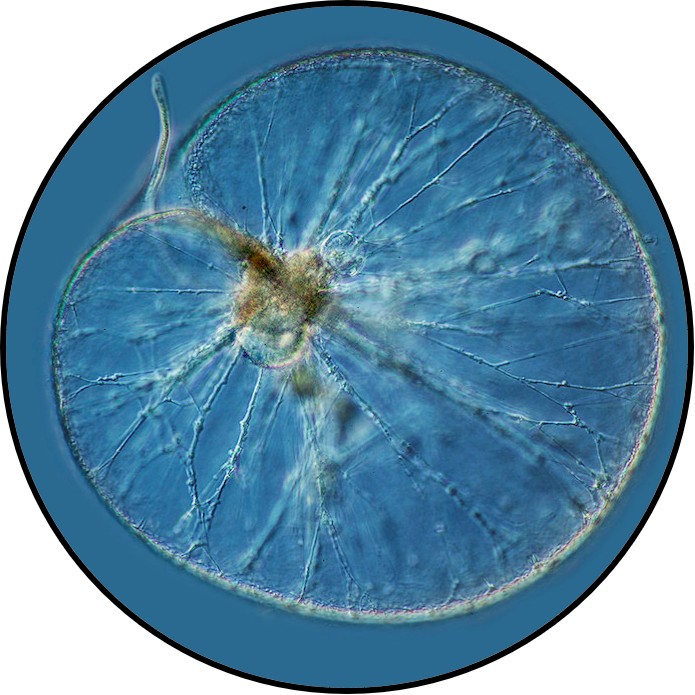
Nutrients feed algal blooms, which support the base of the food web, but can also cause low dissolved oxygen. Interestingly, primary productivity in the Salish Sea has remained stable for several decades. Using nitrogen budgets and sediment isotope analyses, Dr. Sophia Johannesen (Fisheries and Oceans Canada) found that total productivity has changed little since the 1970s.11 However, the composition of phytoplankton appears to be shifting—from diatoms to dinoflagellates—in some basins.11
How are models informing nutrient management?
Observational data and modeling inform nutrient management
Washington State’s marine water quality standards set minimum dissolved oxygen levels (WAC 173-201A-210). Pending EPA approval, both monitoring and modeling data will be necessary to determine 303(d) listings of impaired water bodies. A portion of Puget Sound would be considered impaired if:
- Measured oxygen levels fall below the numeric criteria (4 to 7 mg/L). AND
- Modeled results show natural conditions fall below (or within 0.2 mg/L) of the numeric criteria and that human activities reduce oxygen by more than 0.2 mg/L or 10%, whichever decrease is smaller.

Most of Puget Sound falls below the numeric criteria even without human impacts, so it is important to consider natural conditions. How we draw the line matters—particularly since most noncompliant areas barely exceed the standard.12
Note: The State’s approach to determining natural conditions is awaiting EPA approval for Clean Water Act purposes, including 303(d) listing decisions. In the meantime, modeling studies like Figueroa-Kaminsky et al. (2025) have used reference conditions as a proxy to estimate the extent of dissolved oxygen noncompliance under nutrient-reduction scenarios. That analysis helped inform the Draft Puget Sound Nutrient Reduction Plan and potential future nutrient controls.
Nutrient targets are informed by model results
Model results released in June 2025 underpinned the Draft Puget Sound Nutrient Reduction Plan, Washington’s advanced restoration strategy for meeting marine dissolved oxygen standards. The State ran several scenarios to explore the potential impact of reducing nutrients from marine point sources and watersheds. Proposed nitrogen loading targets were ultimately derived from the Opt2_8 modeling scenario in Figueroa-Kaminsky et al. (2025) and would reduce anthropogenic:
- Watershed nitrogen loads by 53-67% region-wide, and up to 90% in some areas.
- Marine wastewater treatment plants by 68% overall. This includes:
- Capping industrial facilities, small wastewater treatment plants, and plants discharging to Admiralty Inlet, Hood Canal, the Strait of Juan de Fuca, or the Strait of Georgia at 2014 loads.
- Limiting effluent from other wastewater treatment plants to 3, 5, or 8 mg/L, depending on the specific plant and season.
Based on feedback during the public comment period, the State decided additional work is needed before finalizing the Puget Sound Nutrient Reduction Plan.
Model uncertainty limits regulatory confidence
In 2023-2024, Puget Sound Institute convened global experts to advise on how to improve the application of the Salish Sea Model to inform recovery goals and nutrient management decisions in Puget Sound. More recently, Puget Sound Institute reviewed Figueroa-Kaminsky et al. (2025) to evaluate how the model updates and analyses influence the proposed nutrient targets. Our analysis reinforced that:
- Model performance across the Salish Sea is comparable to other models used nationally to set nutrient and water quality standards. However, to our knowledge, Washington is the only state that also relies on modeling—not just monitoring—to determine 303(d) impairment.
- The State made thoughtful refinements that improved model skill and advanced several of the Model Evaluation Group’s recommendations, but model skill may be reaching its practical limits.
- While model skill has improved, existing-condition errors in embayments remain several times higher than the 0.2 mg/L human-use allowance used to define impairment. Although these errors do not directly measure uncertainty in the modeled difference between existing and reference conditions, they provide important context because many noncompliance determinations are close to the threshold—for example, in 2014, half of the modeled noncompliance area was within 0.1 mg/L of the human-use allowance.13
- Additionally, the subtraction of two scenarios may not cancel all relevant uncertainty—especially since the reference condition cannot be validated against monitoring data.13
Credibly implementing Washington state’s standard may require model skill beyond what any model can likely ever achieve. 13
Complex environmental challenges benefit from insights and ongoing advice from scientists in other regions like the Chesapeake Bay and the Baltic, where models have been used to manage nutrients for decades. The University of Washington Puget Sound Institute convened global experts to advise on how to improve the application of the Salish Sea Model to inform recovery goals and nutrient management decisions in Puget Sound. We were lucky to benefit from the expertise of Bill Dennison, Jacob Carstensen, Jeremy Testa, Kevin Farley, and Peter Vanrolleghem.
The following technical memorandum reviews the information provided in Figueroa-Kaminsky et al. (2025) to evaluate how presented model updates and analyses influence the proposed nutrient targets.
What do additional management scenarios show?
Puget Sound Institute has complemented the State’s modeling to run additional scenarios to assess the magnitude of change in dissolved oxygen concentrations from changing specific wastewater treatment plant and river loads, including:
By sharing our model analysis and postprocessing scripts, we hope to spark robust scientific discussion and co-development.
Other models like LiveOcean and SalishSeaCast also help deepen our scientific understanding to inform management actions.
Want to learn more?
Explore regional scientific workshops
Puget Sound Institute’s scientific workshops build on regional discussions like Ecology’s Nutrient Forum and the Marine Water Quality Implementation Strategy to dig deeper into uncertainties like the ‘memory’ from sediment oxygen demand and different species’ vulnerability to dissolved oxygen. We appreciate everyone’s generosity with their time and the valuable insights shared by numerous monitoring experts, modelers, managers, and researchers.

Modeled and historical monitoring insights on water quality differences throughout Puget Sound 02.12.25
Explore the recording, slides, and summary
Browse all the workshop videos.
2026
- Impact of oxygen and temperature on Puget Sound marine life 09.10.26 Slides
2025
- Temperature-dependent oxygen thresholds for marine life 08.15.25 Slides (please note these have been superseded by the report)
- Modeled and historical monitoring insights on water quality differences throughout Puget Sound 02.12.25 Slides | Summary
2022
- Kickoff: The Science of Puget Sound Water Quality 7.26.22 Slides | Summary
- Tools to Evaluate Water Quality 9.29.22 Slides | Summary
- Biological Integrity of Key Species and Habitats 10.06.22 Slides | Summary
- Sediment Exchange 10.17.22 Slides | Summary
- Phytoplankton & Primary Production 12.06.22 Slides | Summary
- Watershed Modeling 12.12.22 Slides | Summary
Read Puget Sound Institute’s articles on nutrients.


Have a question or interested in collaborating?
Email Stefano Mazzilli (mazzilli@uw.edu) and Marielle Kanojia (marlars@uw.edu).
This series of online workshops and research exploring Puget Sound water quality issues affecting wastewater management was funded in part by King County. Its content does not necessarily represent the views of King County or its employees.