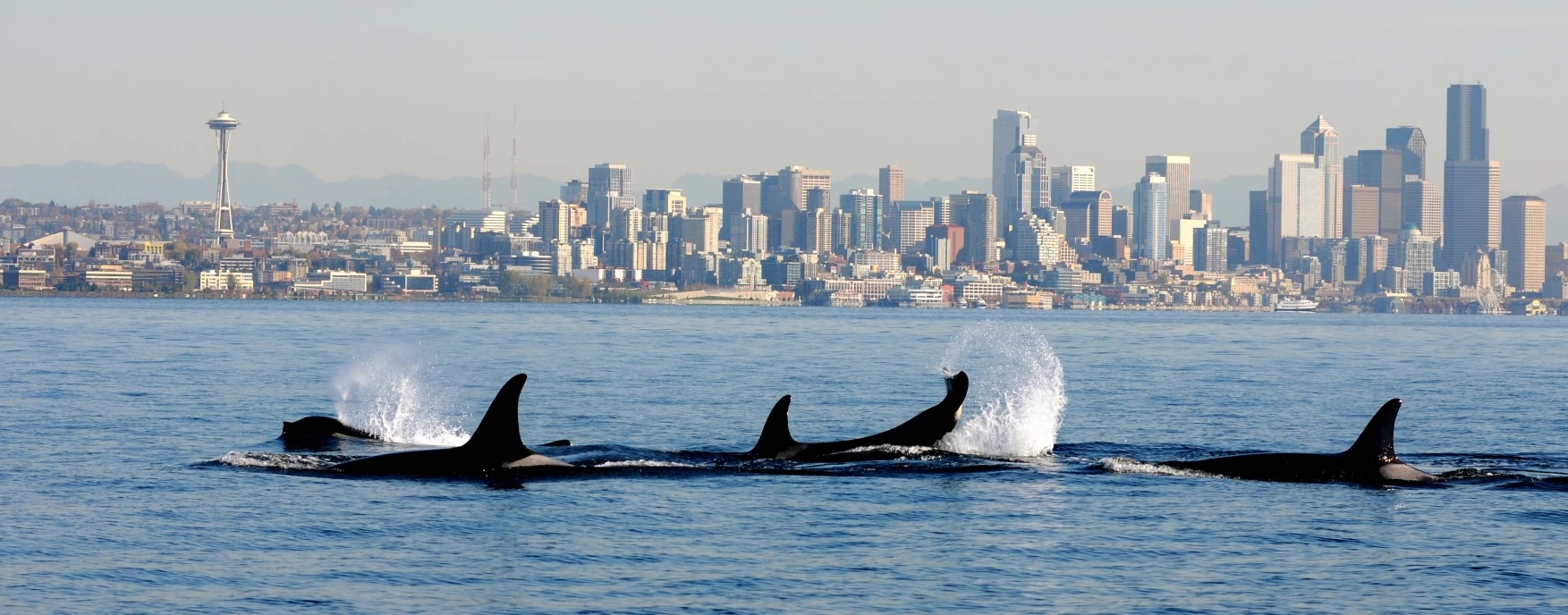
The past, present and future of natural conditions in the United States are described in a new report, which has traveled a bumpy road to its current draft form, now out for public review and comment.
“The Nature Record,” originally titled the “National Nature Assessment,” was launched in 2022 as a government project — the first of its kind. The effort involved more than 160 leading scientists from throughout the country, representing wide-ranging fields of study related to the natural environment.
After President Donald Trump ended the project during the first week of his second term in 2025, the effort was revived as a privately funded initiative with branches into the worlds of art, education and social science.
The volunteer scientists involved in the project, many of whom had waited years for this kind of comprehensive review, were not about to let it die, said Phil Levin, who, as executive director, led the transition from a public to a private enterprise. Outside observers aware of the project expressed a powerful desire to see the work completed.
“It was one of the few times in my career where I have heard directly from hundreds and hundreds of people about the value of something,” said Levin, a conservation scientist who directs EarthLab at the University of Washington. “I always thought we were doing something valuable, but it was good to hear from so many people who reached out and said, ‘Don’t stop!’”
The draft report, now standing at 868 pages with more to come, assesses the status of U.S. habitats — basically the nation’s lands and waters along with the fish and wildlife that live there, as well as the human and natural processes that affect them. The report — formally called “The Nature Record National Assessment” — examines the health of changing ecosystems, including levels of biodiversity. And, in no small way, it also delves into how natural systems underlie and benefit human health, culture and economy.
The report pulls no punches as it describes the loss of species and habitats caused by human development and exploitation of natural resources. But it also describes places yet unspoiled while exploring practical ways to achieve economic benefits without disrupting nature.
Furthermore, the document embraces examples of how human efforts have helped to restore degraded habitats. In fact, one early chapter is dedicated entirely to “bright spots,” where human undertakings and natural resilience have resulted in better-than-expected conditions, given the intensity of past destructive actions.
“We wanted the report to be infused with positive messages about how you can use this information to make changes,” Levin said. “We’ve included a lot of examples of how things work, what is changing in nature, and how our activities are driving those changes.”
A bit of history
As a federal project, the National Nature Assessment had its foundation in the Global Change Research Act, passed by Congress in 1990 and supported by then-President George H.W. Bush, who was advocating scientific research to back up actions on climate change. The law created the U.S. Global Change Research Program, which produced five National Climate Assessments, as required by law, between 2000 and 2023.
In April 2022, in celebration of Earth Day, President Joe Biden visited Seattle’s Seward Park, where he signed an executive order calling for stronger forest protections while addressing fire risks, among other environmental measures. One provision mandated an “assessment of the condition of nature within the United States,” later shortened to National Nature Assessment.
Jane Lubchenco, Biden’s deputy director for climate and environment at the time, had long advocated for more thorough evaluations and planning of natural conditions. An ecologist at Oregon State University, Lubchenco maintained her views through several high-level government positions. Sharing that vision within the White House Office of Science and Technology was Heather Tallis, who served as assistant director for biodiversity and conservation sciences.
Overseeing the fifth National Climate Assessment in 2021, Lubchenco and Tallis successfully pushed for a separate report on nature that would go beyond the subject of climate conditions, according to Levin, who was hired in 2023 as the director of the National Nature Assessment.
That summer, project staff solicited public comments and held a series of “listening sessions” to learn what average people think about nature and to discover the questions they want answered. The result was a a list of topics to be addressed by the report, based on existing scientific knowledge.
Tessa Francis, an ecologist at UW’s Puget Sound Institute, came on board that fall as chief of staff with employment through the U.S. Geological Survey. With the help of an ongoing steering committee, Francis coordinated the assignment of authors to various chapters of the report.
“We have an extremely high caliber of experts comprising our author team,” Francis said. “The motivation of all of us working on the National Nature Assessment was a true belief in the value of the work, the opportunity to create the first-of-its-kind authoritative report about nature.”
Up to 15 authors worked on some chapters, with 15 chapters in the current format, including two yet to be completed. References to original research publications populate the entire report, with close to 5,000 citations listed.
Work on the report was well underway and approaching a first draft when President Trump came into office at the beginning of 2025. In an executive order titled “Unleashing American Energy,” Trump rescinded 12 executive orders relating to energy, climate and the environment, including the one calling for a National Nature Assessment. Dozens of federal employees working on the report from various agencies had to stop work on the report.
A fund-raising effort ensued, generating money from multiple funders to complete the report. The proceeds support core staff, technical editors, graphics artists, website and publication costs, according to Levin. Money is also reserved for a formal review by the National Academies of Sciences, Engineering and Medicine. The nongovernmental scientists who wrote the report remain as volunteers. The Nature Record website lists the California-based Resources Legacy Fund as fiscal sponsor.
A wide-ranging analysis
The first two chapters of the draft assessment report, yet to be completed, include an overview of the project and a discussion about environmental justice, followed by another chapter covering methods of assessing and discussing nature, called “frameworks.”
“Different disciplines, communities and cultures understand nature in different ways, and the breadth of the assessment reflects this,” the draft report notes. “Effective approaches include recruitment of authors at different career stages with diverse perspectives and expertise, working with Indigenous and local knowledge holders, and conducting author training, independent reviews, and public engagement.”
The report expresses the importance of including “indigenous knowledge” in reporting on environmental conditions, and tribal representatives have played a key role in the assessment, Levin said.
The fourth chapter, titled “Bright spots,” emphasizes — by highlighting success stories — that not all human actions are destructive to nature.
“Despite the increasing scale and scope of nature’s decline due to human activities — including from climate change, habitat fragmentation and pollution — scientists, scholars and writers have increasingly found exceptions to these disturbing general trends,” the draft report says. “These exceptions demonstrate both that human actions can result in positive outcomes for nature and that nature itself can be resilient.”
The chapter authors cite numerous species — from northern elephant seals to gray wolves to Puerto Rican parrots — that have been pulled back from the brink of extinction through human actions, such as protecting and rebuilding habitats, banning pollutants and restoring essential waterway connections.
“Interdependence among species in nature mean that actions designed to protect a specific endangered species often increase the health and functioning of entire ecosystems,” the authors report.
The next chapter, Chapter 5, explores the varying relationships that individuals may have with nature, shaped by their values and experiences as well as their cultural, religious and economic views. Discussed are the changing attitudes throughout American history.
Notably, the draft report says, “interactions with nature strengthen feelings of connection, creating a feedback loop that encourages further time spent with nature. Greater connection with nature can also inspire individual and collective action to protect nature — motivating people, groups and institutions to preserve landscapes and ecosystems that may be at risk.”
The next three chapters categorize environmental conditions and trends under the headings marine ecosystems, inland water ecosystems and terrestrial ecosystems.
“Dramatic declines in wetlands, estuaries, oyster reefs and coral reefs,” along with the widespread degradation of other marine habitats, “have resulted in lost livelihoods and cultural experiences and reduced economic, human health and coastal protection benefits,” states the chapter on marine ecosystems.
Many marine species, including salmon, marine mammals and sea turtles, have declined as a result of centuries of exploitation along with recent coastal development, pollution and climate change. Nevertheless, thanks to stronger fishery management, unsustainable fishing has been reined in, resulting in substantial recovery of at least 50 stocks since 2000, as described by NOAA Fisheries.
The chapter proceeds to spell out in detail actual conditions found in estuaries, coastal wetlands, salt marshes, seagrass meadows, kelp forests, mangrove forests, coral reefs, soft-sediment bottom habitats, open-water ecosystems and deep-sea habitats.
Shifting to discussions of freshwater flows and supplies, inland waters are described as the “lifeblood of Earth’s continents … a vast circulatory system of springs, streams, rivers, wetlands, ponds, lakes, groundwaters and aquifers, driven by the sun as its beating heart.”
According to the report, “Inland waters of the U.S. have been overdrawn, polluted, fragmented and subjected to extinction of native species and invasion by non-native species.” Unless current trends change, clean, fresh water is destined to become the most limiting of all resources when it comes to human activity and ecological health, the report says.
Meanwhile, terrestrial ecosystems continue to be altered by human use, resulting in habitat loss and fragmentation of forests, grasslands, shrublands, deserts and tundra, leading to diminished plant and wildlife species as well as human recreation and enjoyment.
On the positive side, a growing awareness of natural systems allows for “working landscapes” to be managed for farming and forestry while better protecting biodiversity and promoting human well-being.
“Conservation faces a fundamental challenge,” the draft report states. “There are not enough resources to protect and restore all the places that are important for ecosystem resilience, biodiversity and cultural values. However, conservation planning can help identify the most effective use of available resources.”
Among the positive examples resulting from a shift in management is a multi-year experiment on Iowa farmland, which showed that replacing just 10 percent of cropland with so-called “prairie strips” doubled species richness among insects and birds. The method also reduced runoff, saving 20 times the amount of soil that would otherwise wash away and quadrupling the retention of phosphorus, a key ingredient in fertilizer that may cause problems for lakes.
Forces for change
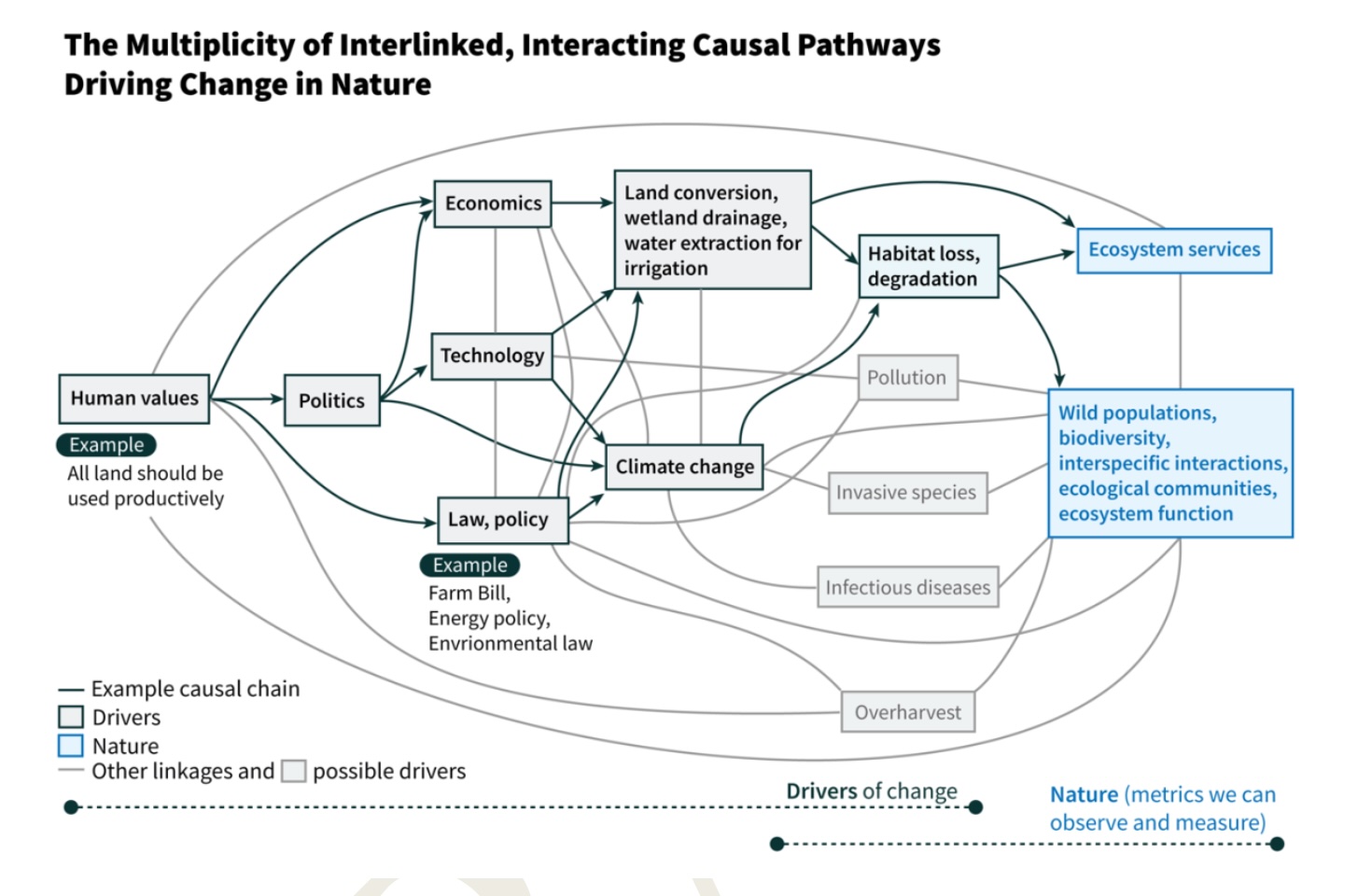
Chapter 9 involves “drivers of change,” with descriptions of how the push and pull of human values have affected the environment throughout history. According to the report, advancing technologies and economic forces have allowed for rapid devastation of natural resources. On the other hand, changing environmental policies are generally improving the protection of natural systems.
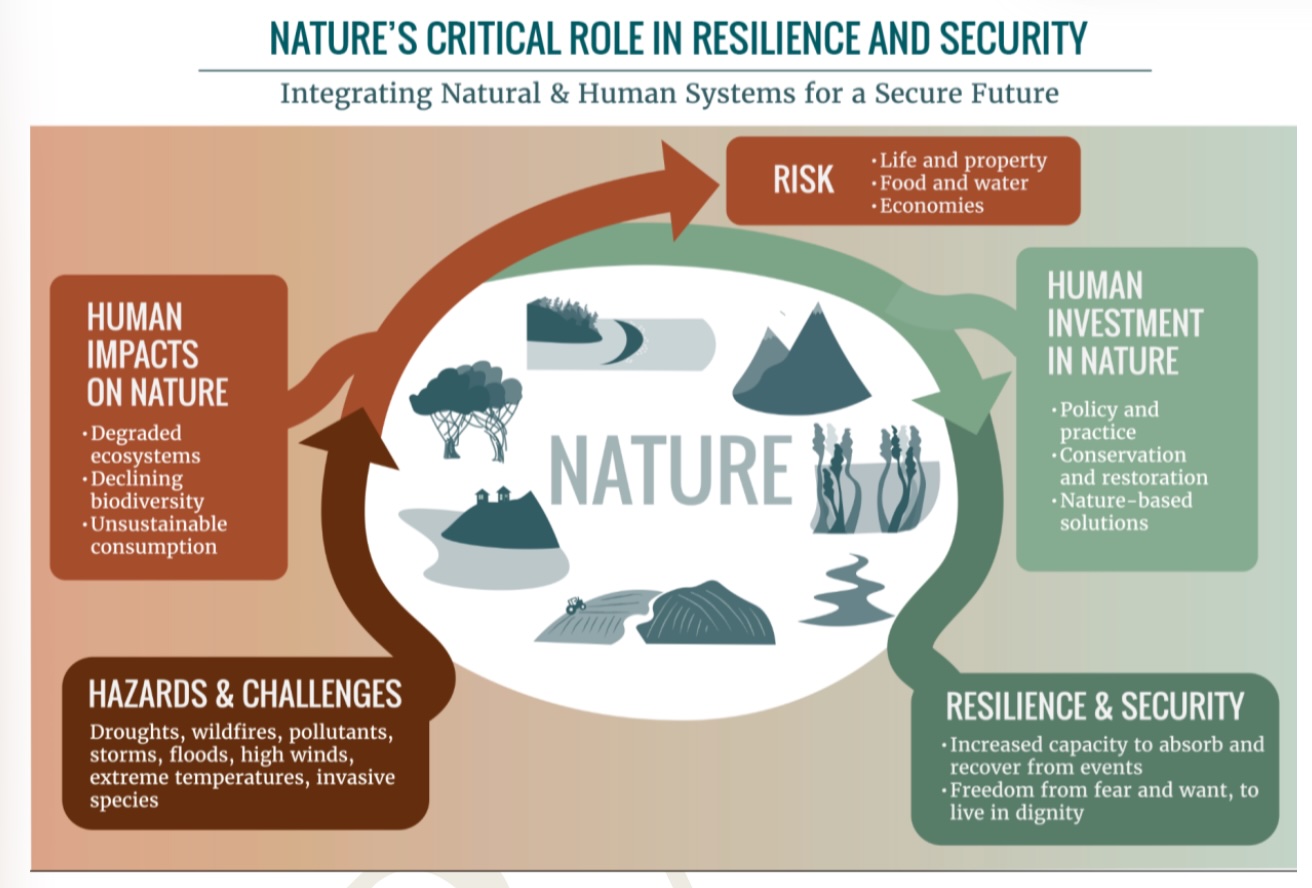
The next three chapters describe how nature is affected by climate change, human culture and the economy, as well as how the economy is supported by nature. Those chapters are followed by one showing how nature can support human health and well-being. Another chapter focuses on ways that nature can help avoid or reduce the risks disaster, such as floods and wildfire, while increasing overall security in the United States.
“There is a growing body of evidence and practice that demonstrates that the security of individuals, communities and nation-states depends on how well we protect and sustain nature,” the report says. “A commitment to new ways of engaging with nature could help protect people and communities against risks and drive societal resilience in a manner that strengthens individual and national security.”
The report concludes with a chapter about how local “place-based” partnerships can foster a natural and cultural environment that meets the needs of humans as well as species sharing the local ecosystem. Working together, partners can heighten success through coordination when carrying out projects. They can use information from previous experiences to set clear goals, incorporate proven methods and track progress. Partnerships work best when local residents are involved in setting priorities, making decisions and maintaining their participation to the very end, the report says.
“Many small projects that restore broken connections, when repeated in enough places and targeted to key parts of a network, can add up to big region-wide benefits over time —including floodplain reconnection, barrier removal in streams, distributed green infrastructure in cities, and migration corridor actions that maintain movement across jurisdictions.”
One example is the U.S. Forest Service’s “shared stewardship strategy,” in which federal, state and tribal entities agree on goals for a given landscape and coordinate actions with local residents and nearby property owners. Joint committees and shared planning processes help to encourage agreements, such as deciding where logging operations can benefit conservation goals.
“Because land and water are linked from headwaters to coasts, actions that reduce risk or restore habitats in one place can shift burdens or create new barriers in another,” the report says. “Coordination across connected systems is therefore also a fairness issue… This equity ‘throughline’ is strengthened when higher-level authorities and funding programs support cross-boundary coordination and require attention not only to where burdens may be shifted but also to where benefits are claimed.”
Comments on The Nature Record are welcome from any interested person until May 30, according to Levin, who wrote a solicitation column for Substack. As explained on the comments page, observations can be made while perusing the document by clicking on “comments” in the floating menu on screen. Alternatively, one can click on “commenting template” on the first page of each chapter to fill in a form that allows multiple comments.
Upcoming events include online webinars as well as in-person sessions across the country.
Future of The Nature Record
The outpouring of public support for completing The Nature Record National Assessment strengthened the commitment of those involved to make the report as scientifically rigorous as possible, Levin said. The National Academies of Sciences, Engineering and Medicine remains in line to review the report, as planned since the initial Biden executive order.
Everyone knew that the report could not thoroughly cover all the available scientific information, Levin said. “You have to make choices about what you are going to highlight.” Most chapters list three “key messages” that the authors want readers to clearly understand, such as “Many tools are available to protect and restore marine ecosystems in the U.S.,” followed by an elaborate explanation.
Each chapter also identifies gaps in available information, which suggest the need for further study and evaluation. Future nature assessments could update the current findings, provided that funding can be found, Levin said.
Meanwhile, shorter pieces of writing are planned to focus on specific issues within the report and make connections between divergent topics. For example, pollution is mentioned as a problem throughout the report, and an issue paper could provide analysis of pollution sources and offer solutions to improve terrestrial, freshwater and marine habitats.
“We could highlight geographies like the Mississippi watershed,” Levin said, noting that conditions related to the river are mentioned in multiple places in the draft report. Land use in the river’s vast watershed affects not only the immediate area but also the streams that flow into the Mississippi, the river itself, its delta and ultimately the Gulf of Mexico. Floods are just one risk along the way.
Beyond the report, staffers at The Nature Record are coordinating with Esri, a GIS/mapping firm, to produce an interactive mapping tool that would allow anyone to “zoom into your neighborhood” to explore various themes. Other educational products could include a children’s book to cover ecological connections and teaching materials for all grades consistent with state educational requirements.
For local, state or national policy makers, explanatory pieces could be written to help lay out the effects of alternative land-use options or restoration projects, based on a scientific evidence.
Much depends on the level of funding that becomes available. As currently structured, staffers at The Nature Record, including deputy director Tessa Francis, are employed by the University of Washington’s EarthLab, an independent institute that operates largely on grants and contracts. EarthLab’s primary mission is to connect environmental science and current research with people in the community.
The concept of a national assessment of nature has grabbed the attention of nature lovers of all varieties, from artists to educators, from farmers to fishermen, and others who work the land and sea.
The interest from poets was strong enough to continue on with an anthology of poetry called “The Nature of Our Times.” Originally planned as a companion to the National Nature Assessment, the project was completed with financial support from a coalition of interest groups. The website contains about 1,300 poems, according to Levin, who wrote the foreward to a book of 230 of the poems published by Paloma Press. See Upcoming Events for online and in-person poetry readings.
The poets and artists involved with The Nature Record are not much focused on trends and data, Levin said. “They appreciate the science, but they connect to the material in a different way. They force you to confront the emotional consequences of human actions, and they are full of hope and wonder along with grief.
“We want to provide a place for people to share their voices, to share examples of ‘bright spots,’” he added. “We believe we can take this national-scale scientific study and make it personal for many people.”
Thank you for working on this valuable Nature Record. As a former Vashon Beach Naturalist, avid beach walker for COASST for over 12 years, and former board member of Vashon Audubon and Vashon-Maury Island Land Trust I have observed changes in the land and water around Vashon and Maury Islands for 50 years and am very concerned. I would like to know more about how changes in the water of Quartermaster Harbor over the past 50 years has affected the phytoplankton and the zooplankton that lives there — and, in turn, other parts of the web of life in the QMH.