By Eric Wagner
A few weeks ago, biologists with the Australian Antarctic Program published a study on bioRxiv, a preprint service that allows scientists to share their work before it has been peer-reviewed. The study was titled, “Mass mortality of southern elephant seals during multi-species outbreak of HPAI H5N1 on sub-Antarctic Heard Island.” In it, the researchers described the deaths of more than 75% of an entire cohort of southern elephant seal pups—more than 13,000 in total.
H5N1 is a strain of highly pathogenic avian influenza (HPAI) known or suspected to have killed hundreds of thousands of seabirds and marine mammals around the world since 2021. Heard Island is an Australian territory thousands of miles from everywhere, and seabirds are thought to be responsible for the virus finding its way there; king and gentoo penguins, as well as a brown skua and South Georgia diving petrel were also found to have been infected with HPAI, although none of them had died to the extent of the elephant seals.
The study served as a reminder that, although years have passed since H5N1was regularly in the news as it killed hundreds of thousands of seabirds and marine mammals, the virus has not finished running its course. And it was for this reason, to keep everyone up to date and on their toes, that the Puget Sound Ecosystem Monitoring Program (PSEMP) held a special topic meeting on June 3 devoted to HPAI, its effects on marine mammals, and its current activities not just on the west coast of North America, but elsewhere as well.
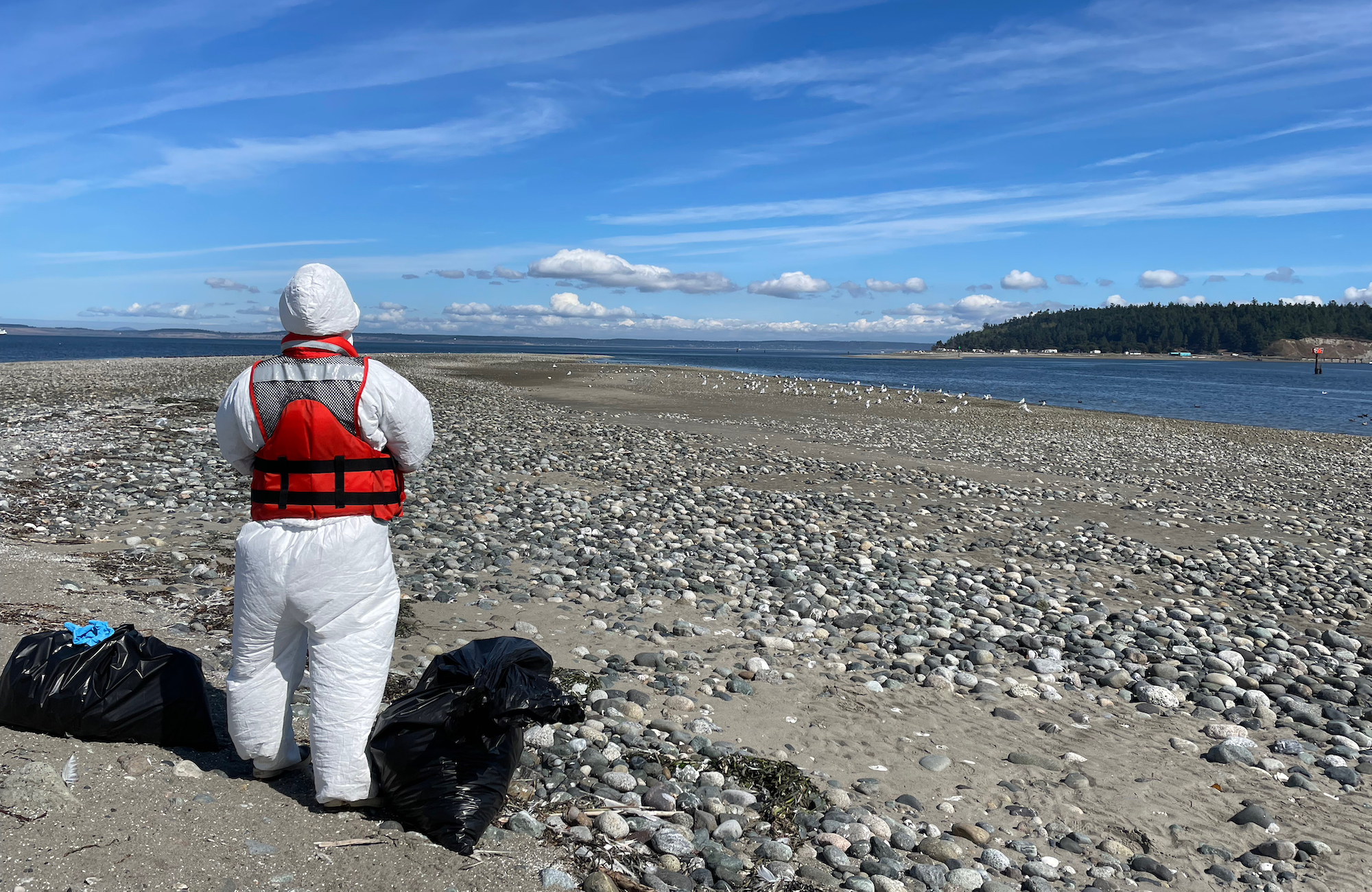
After an introduction to H5N1 from Marguerite Pappaioanou of the Center for One Health Research at the University of Washington, three speakers spoke of their experiences with HPAI. Katie Haman, a wildlife veterinarian with the Washington Department of Fish and Wildlife, started by pointing out that, although the meeting was putatively focused on marine mammals, it is impossible to separate them from marine birds where the effects of HPAI are concerned. “As a disease threat, HPAI is causing a lot of mortality across many species,” she said. An outbreak at Rat Island, near Sequim, for example, led to the deaths of thousands of Caspian terns in 2023 and was part of a larger outbreak suspected to have killed 14% of the species on the North American west coast. Biologists think HPAI associated with that outbreak jumped over to harbor seals; about 150 died in Washington, although there were only five confirmed cases due to limited testing.
That murkiness has made it difficult to assess the full reach of HPAI here. “What is the impact in Washington?” Haman asked at one point. “Unfortunately we don’t really know, because won’t know the number of animals we started with before outbreak occurred.”
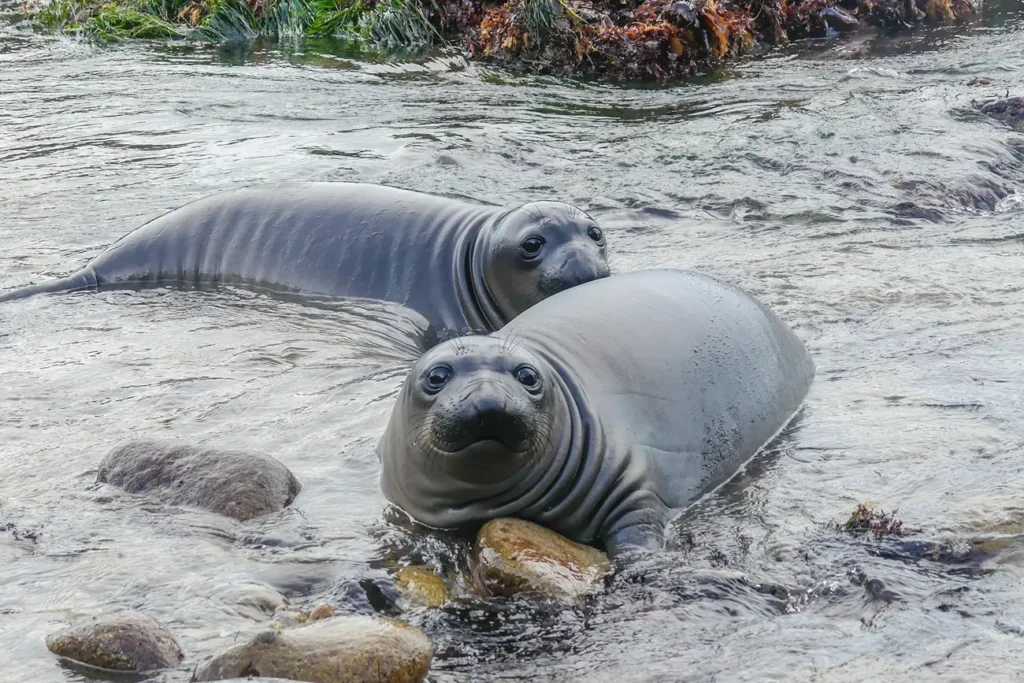
After Haman, biologist Patrick Robinson told of an outbreak of HPAI among northern elephant seals at the Año Nuevo State Park and Reserve in San Mateo County, California that started this past February. Per Robinson, the reserve director and a researcher at the University of California – Santa Cruz, several seal pups exhibited the neurological symptoms consistent with HPAI—convulsions, seizures, lethargy—and tests came back positive for the virus.
State authorities closed the park to the public soon after HPAI had been confirmed; the park’s beaches on the mainland are a popular elephant seal viewing site. Ultimately, more than forty pups died, some on the island, some on the mainland. Mortality rates were significantly higher on the island. “There was an initial pulse, and then a steady flow after that,” Robinson said. But the rapid response may have spared the northern elephant seals the worst. By late March, the event had largely petered out. Public viewing at Año Nuevo was allowed to resume in early April.
The workshop’s final presenter was Marcela Uhart, a wildlife veterinarian who directs the Latin American Program for the Karen C. Drayer Wildlife Health Center at the University of California – Davis. Urhart works primarily in Argentina, and spoke of the devastating HPAI outbreak not only among several southern elephant seal colonies along the southern coast of Argentina, but throughout South America. From its arrival on the Pacific coast in 2022, in Peru and Chile, through its later movement to the Atlantic coast, HPAI left a trail of dead wildlife. In Argentina alone, tens of thousands of elephant seal pups and subadults perished, the beaches littered with their carcasses. The effects, Uhart said, are still being seen, with counts of female elephant seals and weaned pups down more than 50% and 70%, respectively, while adult male counts are down by 35%. “We saw the southern elephant seal go from being a species of Least Concern to Vulnerable on the IUCN Red List,” she said.
Uhart ended with a general warning. “South America as a critical case study,” she said. “You have to be prepared, but there isn’t much you can do. The California outbreak of elephant seals, showed how good things can go when there is early detection. But there is just no return in many cases.”
It was a solemn closing note. Meanwhile, in the Salish Sea region, confirmed cases of HPAI continue to trickle in: a mallard, two trumpeter swans, and a Canada goose in Snohomish County; four cackling geese in Whatcom County, and a glaucous-winged gull in mid-January; a couple of weeks after that, in Skagit County, a crow. The virus, unfortunately, is still lying in wait.