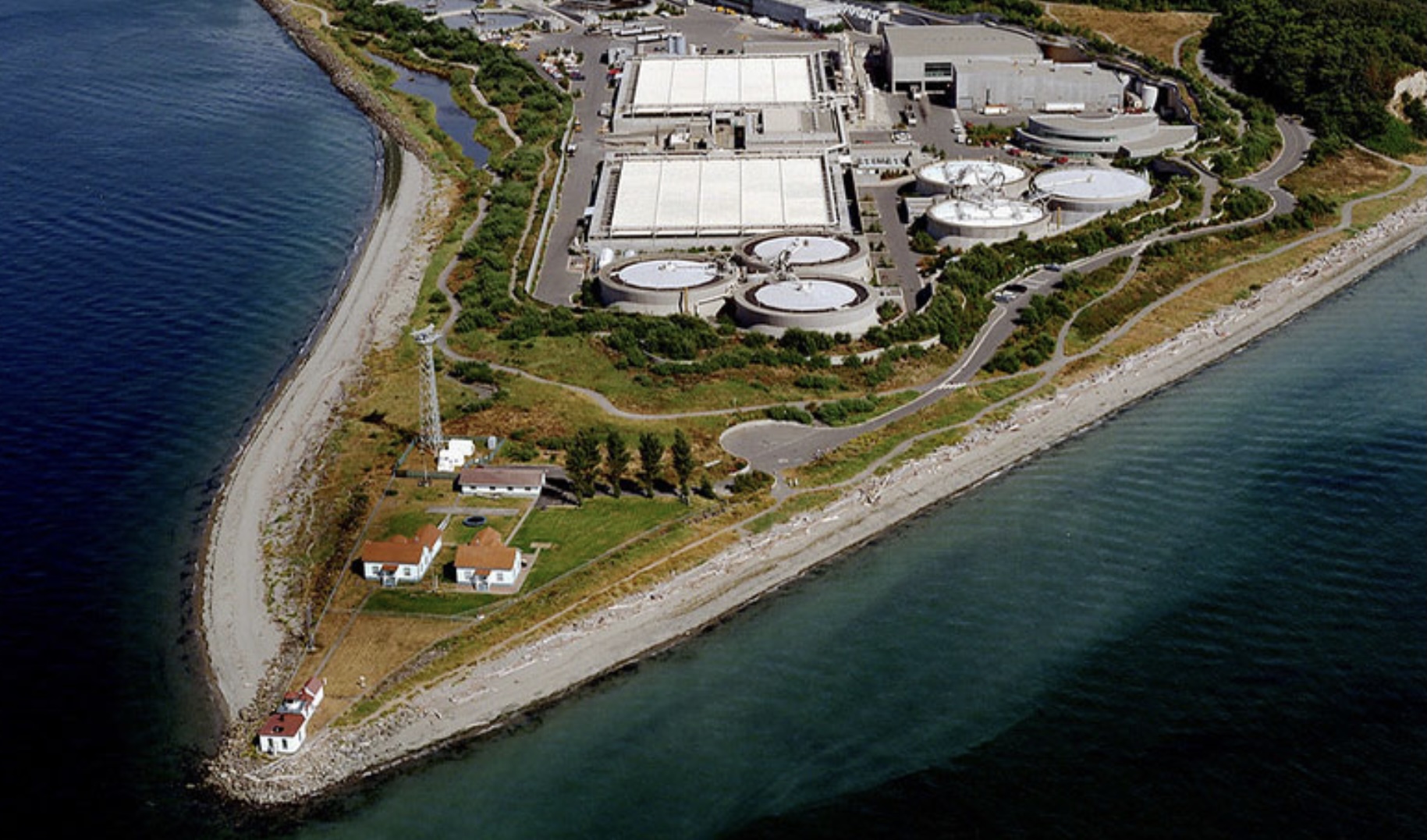
Regulatory efforts to confront low-oxygen problems in Puget Sound have turned toward sewage treatment plants, as the Washington Department of Ecology proceeds to reissue operational permits, some ahead of the normal five-year schedule.
Excess nitrogen has been found to contribute to low-oxygen problems in Puget Sound, and computer models have identified locations where reducing nitrogen in sewage effluent could improve water quality. Since June, 18 draft wastewater permits have been released for public comment, all containing provisions to address current and future discharges of nitrogen in sewage effluent.
Five years ago, Ecology originally proposed a new “nutrient general permit” to specifically begin controlling nitrogen from sewage treatment plants. But courts ruled that the state could not impose new permits for wastewater on top of existing ones — which all treatment plants must have. After considering a “voluntary” permit, Ecology eventually abandoned the general permit altogether, announcing that it would instead address nitrogen by updating the existing individual permits, one by one.
Meanwhile, the Puget Sound Nutrient Reduction Plan, designed to address all sources of nitrogen entering Puget Sound, remains under wraps. A draft of the plan, released in June 2025, resulted in extensive public comments and efforts to revise the plan. Six months after the plan’s public release, Ecology announced: “We have also determined that we have more work to do on our Puget Sound Nutrient Reduction Plan, which is Ecology’s approach to guiding the region in addressing the many human sources of nutrient pollution.”
Since then, in discussions behind the scenes, Ecology officials have been working on the “technical foundation” for establishing formal nutrient limits in permits and evaluating the resulting water quality improvements, according to Ecology spokesman Jeff Zenk.
“In the coming months,” Zenk said in an email, “Ecology will begin meeting with stakeholders about assembling a new nutrient group to address outstanding policy and technical decisions, as Ecology works toward finalizing a Puget Sound Nutrient Reduction Plan. Major decision areas include application of water quality standards, nutrient reduction strategies, equity in distributing nutrient allowances, funding approaches, monitoring, and accountability.”
In the wastewater permits coming up for review, requirements depend on the size and location of the various treatment plants. The first permit modifications were proposed for three large treatment plants: King County’s West Point Wastewater Treatment Plant in Seattle, Bellingham’s Post Point Wastewater Treatment Plant, and Everett’s Water Pollution Control Facility. On Sept. 18, the latest proposed permits were issued for two other large facilities — Tacoma Central Wastewater Treatment Plant and Chambers Creek Regional Wastewater Treatment Plant.
Nearly all the draft permits include proposed “action levels” designed to maintain or reduce the amount of nitrogen released while sewer officials plan for plant upgrades to reduce nitrogen loading. Action levels are based on average nitrogen releases in recent years. If the action levels in the permits are exceeded, the facilities would be required to take actions to reduce nitrogen releases back to those levels.
A few treatment plants, such as LOTT (Lacey, Olympia, Tumwater and Thurston) are based on designs that remove nitrogen from their effluent. Their permits contain legally enforceable nitrogen limits — a major step beyond the action levels being considered in the new permits.
Most of the proposed permits require treatment plant operators to develop nitrogen optimization plans, which consider various ways to reduce nitrogen releases from each plant without major new construction.
Most draft permits also call for a “nutrient technology assessment,” Zenk noted. “Each facility must evaluate the treatment technologies it can reasonably build to achieve the best possible nitrogen reduction while keeping sewer rates affordable,” he explained. “These assessments will guide future nitrogen limits and are expected to provide the greatest nitrogen reductions possible with today’s technologies while balancing affordability.”
A nutrient technology assessment closely aligns with a state requirement that “All Known, Available and Reasonable Methods of Prevention, Control and Treatment” (AKART) be used for reducing pollutants. The assessment examines the latest treatment methods with consideration for upgrades that a community can reasonably afford.
Permit officials at Ecology are reviewing comments received on the 18 proposed permits issued so far, but they have not yet completed any. In all, 58 sewage-treatment plants were included in the computer model used to assess the effects of nitrogen removal. For permits not yet under review, priority depends on the size of the treatment plant, its proximity to low-oxygen waters, and how long it has been since the last permit review, along with non-nutrient issues, such as other effluent chemicals, plant design changes and compliance problems.
According to Zenk, comments reflect a wide range of interests, from concerns about costs and the pace of investments to expressions of urgency and the desire to reduce nutrient pollution as soon as possible.
King County wastewater officials expressed numerous concerns about the proposed permit for the county’s West Point plant in Seattle, including questions about basing action levels on historical nitrogen releases from 2021 to 2025, a period that includes the pandemic.
“Loading continues to increase for West Point as commercial activity recovers from the pandemic and the city’s population grows,” said Kamuron Gurol, director of the wastewater division, in a written comment on the proposed permit. “We question whether setting a load value based on past performance is appropriate without an allowance for growth, especially given the anomalous specific years used as the baseline.”
Gurol said improving low-oxygen conditions in Puget Sound is a complex challenge that must be guided by science and careful consideration of financial conditions.
“Upgrading the dozens of wastewater treatment plants that discharge to Puget Sound for nutrient treatment will be one of the largest investments in water quality in state history…,” he said. “King County’s sewer rates are forecasted to double in the next six years and will grow further over the next 20-year forecast period, before factoring in larger nutrient treatment upgrades. Nutrient upgrade costs are likely to be measured in billions of additional dollars. We must get this right.”
Puget Soundkeeper, an environmental group, has commented on several of the proposed permits, saying what is really needed to address the low-oxygen problems in Puget Sound are legally enforceable limits on the release of nitrogen from sewage treatment plants that will actually reduce nitrogen loads to Puget Sound.
Based on computer modeling, Ecology has known since 2019 that sewage-treatment plants are the largest contributor of human-caused nitrogen going into Puget Sound, said the group’s staff attorney Kathryn Rizzo in a comment letter. State laws prohibit the discharge of pollutants that create violations of the state’s water quality standards, she wrote, and Ecology’s own rules say no permit may be issued if it contributes to such violations.
Treatment facilities throughout the country have been able to reduce nitrogen levels to below an average 3.0 milligrams per liter, establishing that as a reasonable limit that should be enforceable, she said in a comment letter on the West Point plant. Without a limit, the plant will “continue discharging nutrients at its current uncontrolled level — a level that Ecology has found contributes to violations of water quality standards.”
Ecology’s approach has been to study the overall problem, develop long-range plans, and require treatment plants to analyze what is technologically and financially feasible before moving forward with strict limits on nitrogen releases at every treatment plant.
Note: Comments from King County were received and added to this blog post after initial publication.
For more details about Ecology’s efforts to control nitrogen in Puget Sound, read the March article “State adjusts strategy to address low-oxygen levels in Puget Sound.”
No Comments yet!