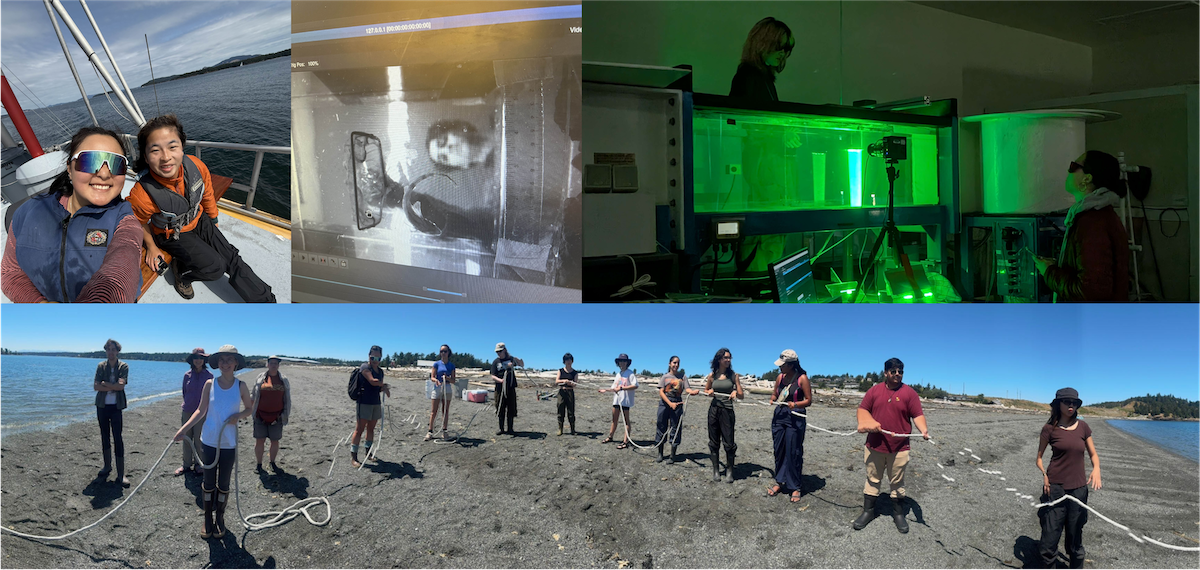
The Puget Sound Institute is helping to support two undergraduate internships at Friday Harbor Labs this summer.
This article is courtesy of Dr. Cassandra Donatelli of the University of Washington Tacoma School of Engineering and Technology.
Researchers from all over the world come together at the University of Washington Friday Harbor Laboratories to ask and study questions about marine science and engineering. This summer, two UW Tacoma undergraduates will join them as part of a full immersion research experience that offers one-to-one guidance from marine scientists.
The internship, part of the NSF Blinks Summer Research Experience for Undergraduates (REU) Program, combines the National Science Foundation REU with the Anne Hof Blinks Research Fellowship for groups underrepresented in the marine sciences.
It is a nationally recognized program that pairs undergraduates with scientist-mentors for original, hands-on marine research. The student participation is made possible with support from the UW Puget Sound Institute, the Center for Urban Waters, the UW Tacoma Office of First Gen, and the UW Tacoma Founders Endowment.
Friday Harbor Labs is a residential research community where students and researchers live on campus, eat together in the dining hall, and spend their days working with faculty, graduate students, and researchers from institutions around the world. The NSF REU-Blinks program is designed to immerse students in that environment. They work one-on-one with a mentor for roughly 40 hours per week, contributing to real research projects. Over 80% of participating students have presented their findings at academic conferences, and many have gone on to publish in peer-reviewed journals.
Beyond those academic achievements, students also build a professional network and a scientific identity by living and working alongside peers from different disciplines, from ecology, biology, oceanography, mechanical engineering, fisheries science, and more. For many, Friday Harbor is where they meet future graduate advisers and decide that research is the path they want.
Both projects are prime examples of interdisciplinary research in practice and exactly what the recently funded BIOPODE (Biomechanics, Integrative Ocean Physiology, and Organismal Development and Evolution) NSF REU Site grant hopes to achieve in the coming years. The NSF REU-Blinks program brings together students from backgrounds historically underrepresented in marine science, and UW Tacoma’s participation extends that mission to a campus that serves a distinctly diverse, often first-generation student population. By immersing students in a collaborative, cross-disciplinary research community, the program shapes how students think about problems, who they think they can work with, and what kinds of questions they ask.
UW Tacoma students will research coastal fog and wave energy
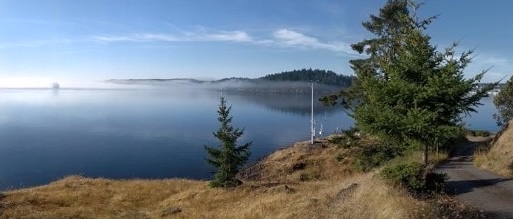
Isabella Claeson (Sophomore) will spend her summer deploying timelapse cameras and temperature sensors across San Juan Island, building on a dataset that stretches back to 2021. Her project, led by Jessica Lundquist, UW Civil and Environmental Engineering, focuses on coastal fog: the low, fast-moving cloud layer that rolls in from the Pacific and dramatically shapes conditions along the shore. For intertidal organisms, low tide during a summer heat wave can be a death sentence, and fog may offer some relief. Isabella will analyze local temperature and humidity data against regional ocean temperatures, winds, and tide patterns, and then compare those observations against forecasts from high-resolution weather and ocean models. This work sits at the intersection of climate science, ecology, and environmental data analysis.
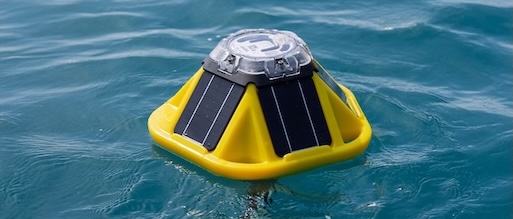
Dani Cortez (Junior) will be working on a project asking whether the ocean can power its own science. Working with Molly Grear and Linnea Weich, Pacific Northwest National Laboratories, and Cassandra Donatelli, UW Tacoma Mechanical Engineering, Dani will deploy a Spotter wave buoy at FHL to measure local wave conditions and evaluate whether small-scale wave energy converters could realistically power on-site equipment like environmental sensors. Dani will also explore how marine organisms orient themselves in moving water, and test how those biological strategies might inspire the design of self-orienting wave energy devices that don’t rely on complex mooring systems. The project combines fluid dynamics, biomechanics, renewable energy, and marine biology.
Dr. Cassandra Donatelli is an assistant professor at the University of Washington Tacoma School of Engineering and Technology.