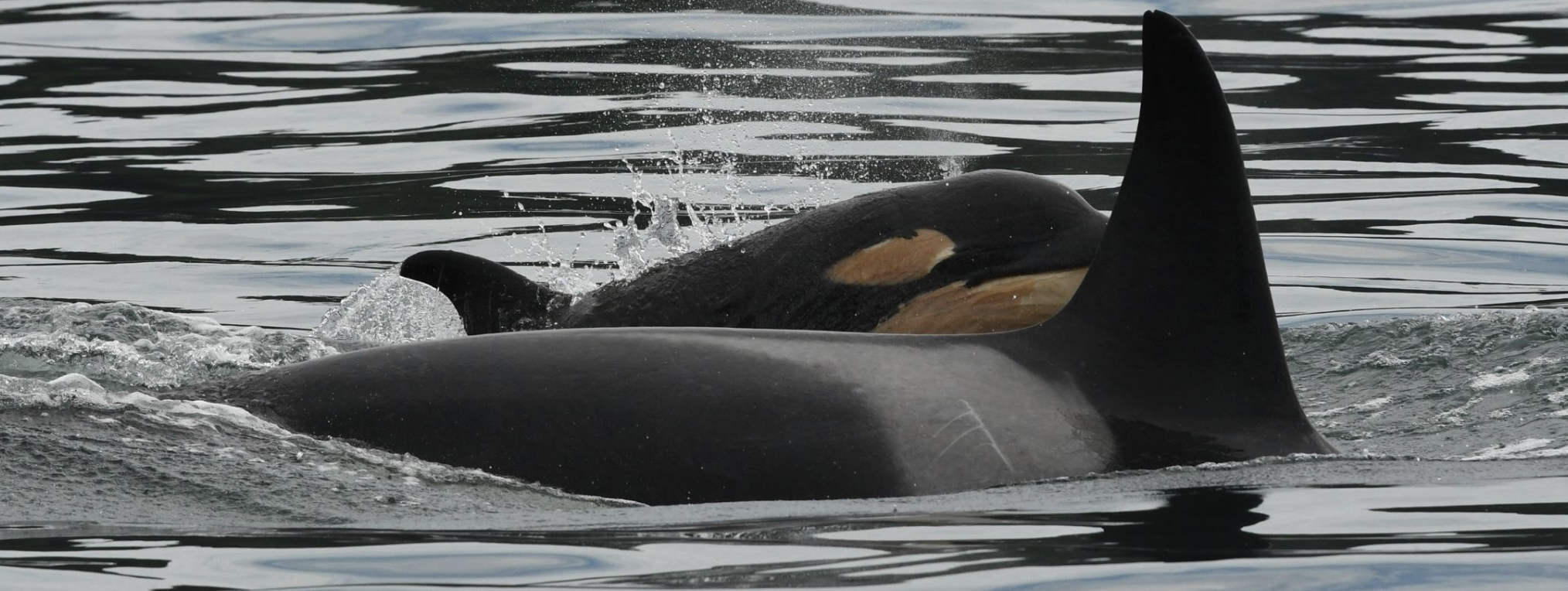
Pending one final check, it appears that this year’s census of the endangered southern resident killer whale population will show a positive increase of two orcas — an annual increase equaled only four times in the past 20 years.
The Center for Whale Research, which conducts the annual census, needs one more encounter with a group of 19 whales in L pod to be sure that no recent births or deaths will alter the count, according to Michael Weiss, research director for CWR. This group of whales, known as the Greater L4 subgroup, includes a new calf, L130, first seen last month.
No deaths have been reported this past year among the adults and juveniles in the southern resident population. If no changes are observed during another encounter with the L4s, the population will stand at 76 — a level not seen since 2017, when the three pods consisted of 77 orcas. The annual census is a count of the whales as of July 1.
This year, the Center for Whale Research celebrates 50 years of counting every birth and death in the southern resident community. (Read on below for observations from the early years.)
Putting the numbers together
Michael Weiss and his fellow researchers took a boat trip to the outer coast early this month to check on the southern residents foraging in a rich feeding area known as Swiftsure Bank, which lies near the entrance to the Strait of Juan de Fuca.
“We are really lucky that no one was missing,” Michael told me after the visit. “We do want another encounter with the L4s to make sure everybody is still there. We are hoping for a census year without a death (among older whales), but we still need to confirm that.”
The L4s were last seen with a new calf in mid-June along the west side of San Juan Island. The calf seemed healthy and was estimated at 1 to 3 months old at the time, Michael said. Although the calf was swimming with L91, a 31-year-old female named Muncher, the researchers could not be sure that she is the mother.
The calf appeared to be bouncing around among the nearby females, Michael said, which is typical for a calf that age. More observations are needed to confirm the mom as well as the sex of the calf, he added.
The new calf, L130, is a welcome addition to the population, and everyone hopes that it can survive a risky period that occurs during every calf’s first two years of life.
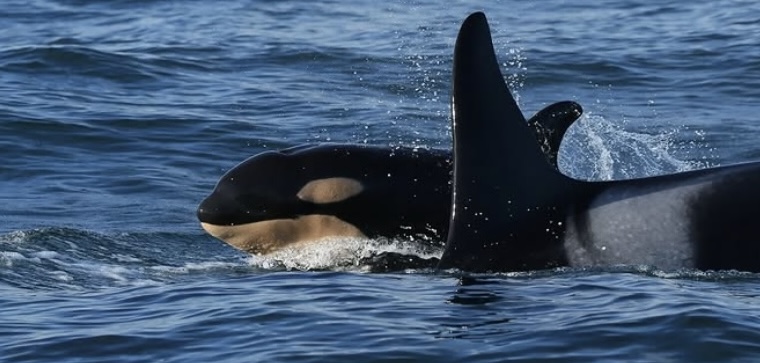
The other new addition to the population is K47, first spotted in December. After recent sightings, CWR biologists now believe K47 is likely the offspring of K43, a 16-year-old named Saturna. If confirmed, this would be Saturna’s first calf.
Another calf, L129, was born in February and was not seen again when researchers observed the pod in June. The mother could not be positively identified and likely will remain a mystery. L129 will be reported as both a birth and death in the next report.
Another birth followed by a much-too-soon death is J64, the first confirmed calf of an 18-year-old female named Echo, J42. The baby was born in September of last year and was missing during an encounter on Oct. 23, according to CWR. At this time, these two early mortalities are the only deaths listed for the upcoming census report, to be submitted to the federal government by Oct. 1.
Growth target for endangered species
An increasing number of southern residents is considered necessary to avoid extinction and reach a path to recovery. Yet, since 2006, there have been 11 years with declining populations and only seven with increases. Years with increases were 2010, when the count went up by one; 2011, up by one; 2015, up by three; 2016, up by two; 2021, up by two; 2023, up by two; and 2025, up by one. Over that time, the total number has declined from 89 to 74 whales (last year’s census count).
To meet recovery goals established under the Endangered Species Act, the southern residents must maintain an average growth rate of 2.3 percent per year for 28 years. If that same rate is achieved over 14 years, the southern resident population could be down-listed from endangered to threatened, according to the 2008 “Recovery Plan for Southern Resident Killer Whales.”
If the increase of two animals becomes official this year, that represents an increase of 2.7 percent. Unfortunately, to maintain a 2.3 percent average increase, a much higher growth rate is needed in some years to compensate for those years with more deaths than births. So far, we have not seen this kind of turnaround.
“We need sustained, consistent population growth,” Michael said, adding that it is important to acknowledge gains when they come. “As of this moment, based purely on demography, it looks like a pretty good year.”
Body condition of the whales
In recent years, the organization SR3 — Sealife Response, Rehabilitation and Research — has been assessing changes in the overall body condition of endangered southern resident killer whales by taking precise measurements from aerial images recorded by drones. Last week, the researchers were with the whales on Swiftsure Bank in ocean waters between Washington and British Columbia, Canada. The southern residents aggregate there at times to take advantage of larger numbers of Chinook salmon — their preferred prey — found in that area.
New data on the summer body condition of the whales will be added to SR3’s long-term photogrammetry dataset after the team finishes analyzing the aerial images, said Holly Fearnbach, marine mammal research director for SR3. In some years, the team has been able to collect adequate data in the Salish Sea, but lately the whales have been visiting local waters less frequently because of declines in the number of Chinook, notably those returning to the Fraser River in British Columbia.
Aerial images were collected last fall during drone flights at elevations greater than 100 feet to provide a non-invasive health assessment of the whales. Measurements of “fatness” in a prescribed location behind the head is considered a strong indicator of nutritional body condition.
“For the first time since the start of the study in 2008, we documented increases in typical condition for all three pods since the previous assessment in late 2024, following five years of consecutive decline by J pod,” states the report based on last fall’s data.
The improvement was driven by a lower number of whales identified to be in the worst of five assigned body-condition states, ranging from “robust” to “poor.” Fourteen whales were listed in “poor” body condition in the latest report, compared to 22 in late 2024. Those listed in poor condition are considered to be at greater risk of mortality.
Similar to the past two years, about one-third of the whales in L pod were considered to be in “poor” body condition last fall. In contrast, about two-thirds of the animals in K pod were listed in either “robust” or “above normal” body condition, with just 8 percent listed in “poor” body condition.
Nearly one-third (30 percent) of whales in J pod were considered to be in “robust” body condition with 15 percent identified in “poor” body condition. Nineteen percent of J pod was reportedly in “normal” body condition, with equal percentages for both “sub-normal” and “above normal” states.
The SR3 team also assesses pregnancy and subsequent reproductive success among the whales, using their quantitative measurements. Similar to previous years, it appears that several females have experienced failed pregnancies since November. Fortunately, several successful pregnancies have occurred over the past few years, Fearnbach said. That’s an essential factor in maintaining or increasing the population.
Population counted for 50 years
The annual count of southern killer whales began in 1976, when marine mammal researcher Ken Balcomb received a contract from the federal government. The key question involved how many orcas were left in Puget Sound after nearly 50 southern residents were captured for aquariums and removed from the population.
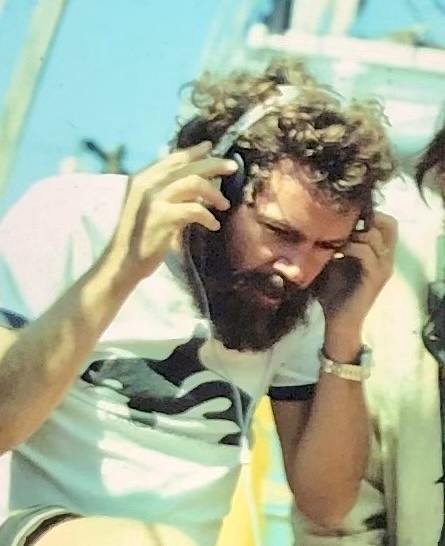
Now, with the 50th anniversary of the first census at hand, we can celebrate Ken’s determination to maintain an annual record of all the births and deaths in the three orca pods — an effort that has continued past Ken’s death in 2022 at age 82. The precise record has been used in numerous studies calculating the risks of extinction for these whales that still return to Puget Sound — even though the waters are no longer the bountiful feeding grounds of years gone by.
The ability to keep track of every single whale was made possible through a discovery by the late Canadian researcher Mike Bigg. Through extensive observations, Bigg came to realize that each whale had unique markings that could identify it as an individual, not just a member of a herd. Bigg made careful notes of the size and shape of the dorsal fin as well as the unique light-gray pigmentation behind the fin, called the saddle patch.
Ken’s son, Kelley, recently recalled that during the first year of the Orca Survey in Puget Sound, his dad would call Mike on the phone and describe the markings of various whales. In the 1970s, it was not easy to send a photograph.
“Mike would immediately know the whale my dad was talking about, simply by the description over the phone,” Kelley told me, adding that Ken obtained 8-by-10-inch photographs taken by Bigg for each whale’s dorsal fin and saddle patch. The ID photos were always from the whale’s left side, which became the standard practice.
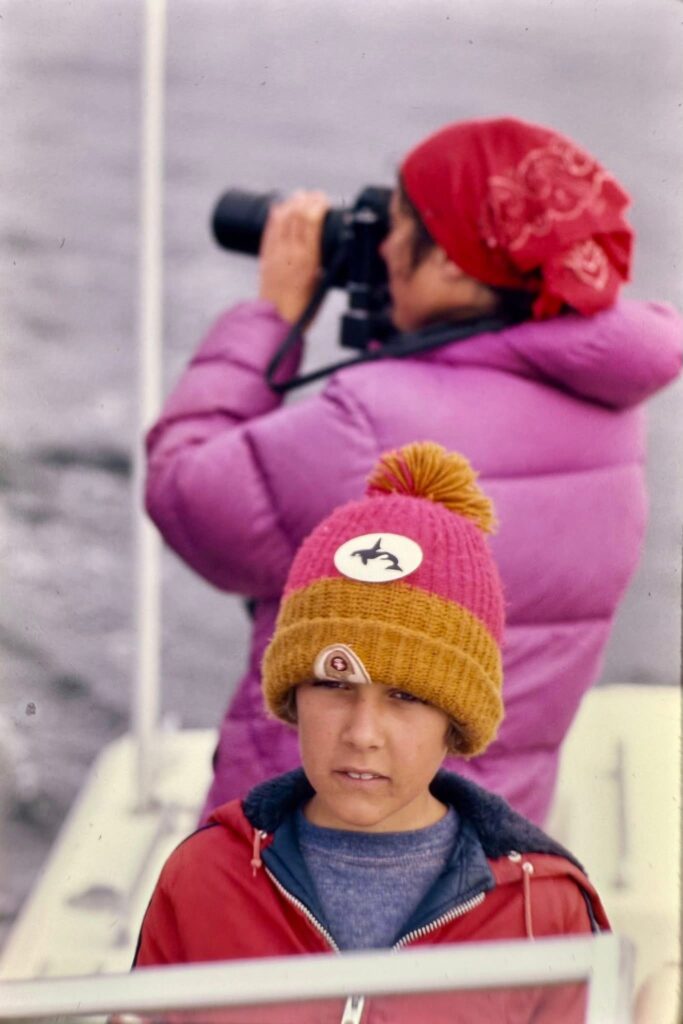
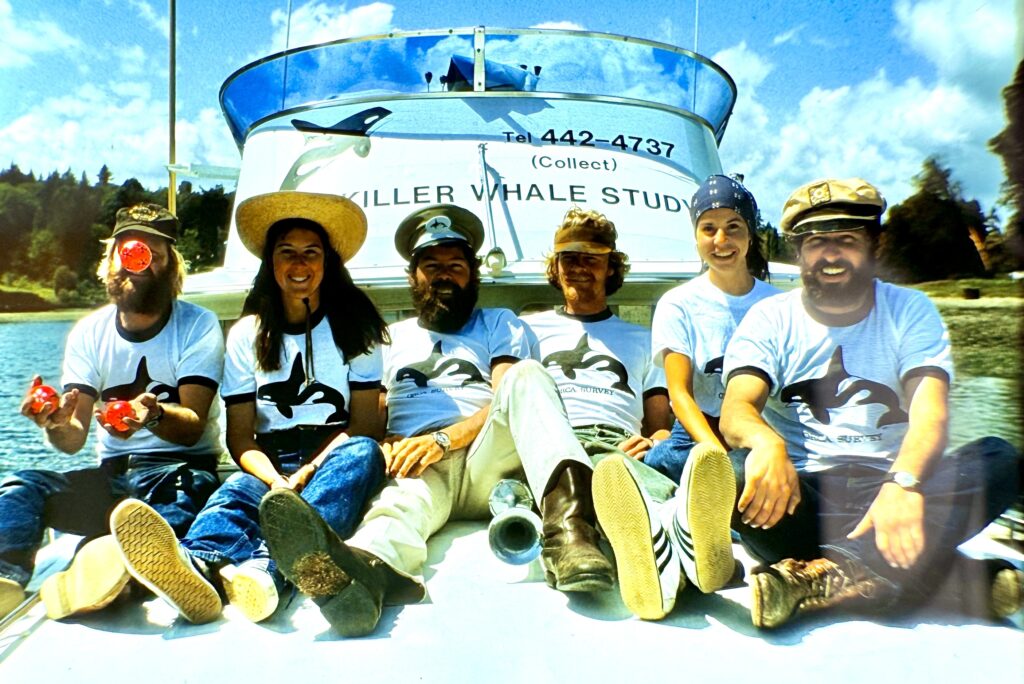
During the first year of the Orca Survey, the core team consisted of Ken Balcomb, his wife Camille Goebel and Rick Chandler, now deceased, who was a friend of Ken’s from the Navy.
Kelley, whose parents were divorced, spent each summer with his dad. At 13 years old, he became part of the orca research team during the first year of observations from a boat. Since his dad’s death, Kelley has obtained photos showing his first trip with Ken and Camille on June 16, 1976.
“We were watching J pod moving in tight groups off Edmonds,” Kelley recalled. “Camille started taking pictures, then I took the wheel, so Dad and Camille could both take pictures.”
Through the years, Kelley became an expert at driving boats near killer whales with minimal disturbance and always for research purposes. “You learn to pace them and let them get comfortable with the boat,” he said. “You are trying to get positioned for the best photos.
“I will never forget the feeling of being in the presence of the whales and being in awe of them,” he said. “Here they are, massive animals, much bigger than horses, and they are swimming alongside at high speed.”
Camille was equally impressed, although she recalls her effort to maintain a scientific aloofness, focusing on the work of getting clear photos, taking careful notes and drawing pictures to describe the whales’ behaviors — such as breaching, when a whale launches itself out of the water and falls back with a splash. About 17,000 photographs were taken that first year alone.
Camille met Ken at the University of California Santa Cruz, where she was an undergraduate studying marine mammals. Ken was a graduate student and teaching assistant for the class. After they were married, they began doing research together, including a study of gray whales in Mexico. Ken was eager to study the orcas that he considered as part of the “backyard” for NOAA’s National Marine Mammal Laboratory, which had an office in Seattle. (In 2015, “National” was dropped from the name of the lab.)
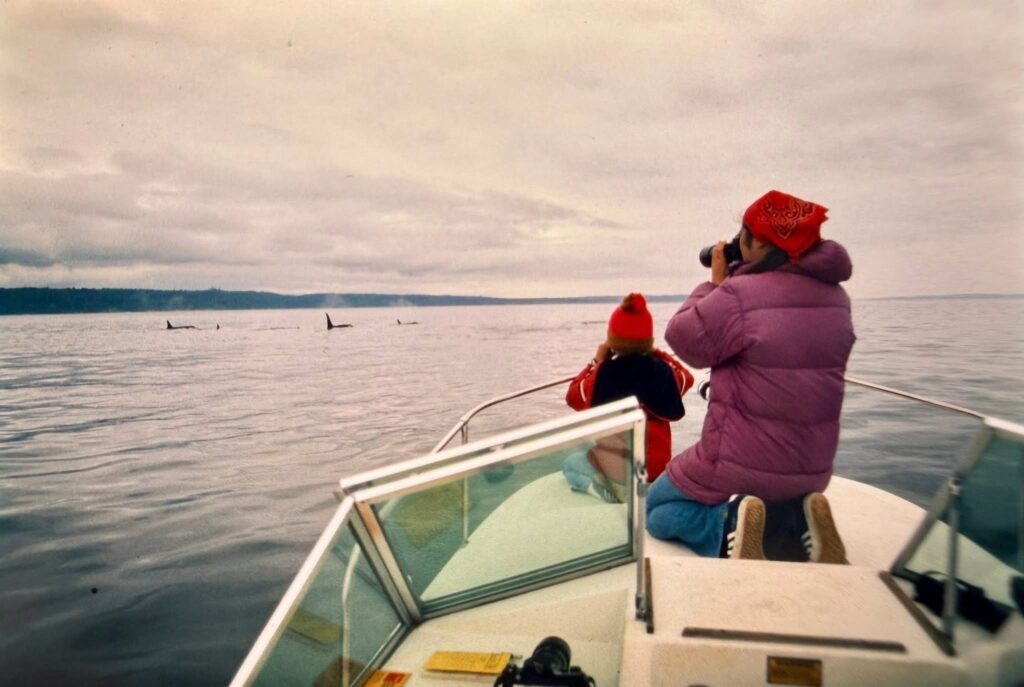
It was the end of the capture era, which had left a lingering feeling of despair among those who understood the social structure of Puget Sound’s orcas, Camille said. “I thought it was horrible; they were tearing families apart,” she said.
Mike Bigg had ID photos of most of the southern residents, but the Orca Survey identified a few more whales in the three pods, and always there were new calves to report and associate with their mothers.
“It didn’t take long before we got to know the whales,” Camille said. “The new calves were always fun to see. Like any young animals, they like to play. One time, this calf found a harbor porpoise and was chasing it around and then flipped it into the air. I had never seen anything like that. I don’t know if it ever bit into it; I didn’t see any blood.”
The whales would often stick their heads out of the water to look at the people, a maneuver called “spy hopping,” she noted. “It’s like, ‘I’m looking at you; you’re looking at me.’”
Camille said it was exciting to see the big males approach the boat, although the researchers never experienced any aggression. One can only imagine what takes place under the water, out of sight to humans on the surface, she added.
Giving the whales an identity
The ID system developed by Mike Bigg grouped the southern resident whales into J, K and L pods. Earlier letters in the alphabet were assigned to the northern resident whales of British Columbia. Bigg chose large males to be designated J1, K1 and L1 in their respective pods. Other numbers were assigned somewhat arbitrarily.
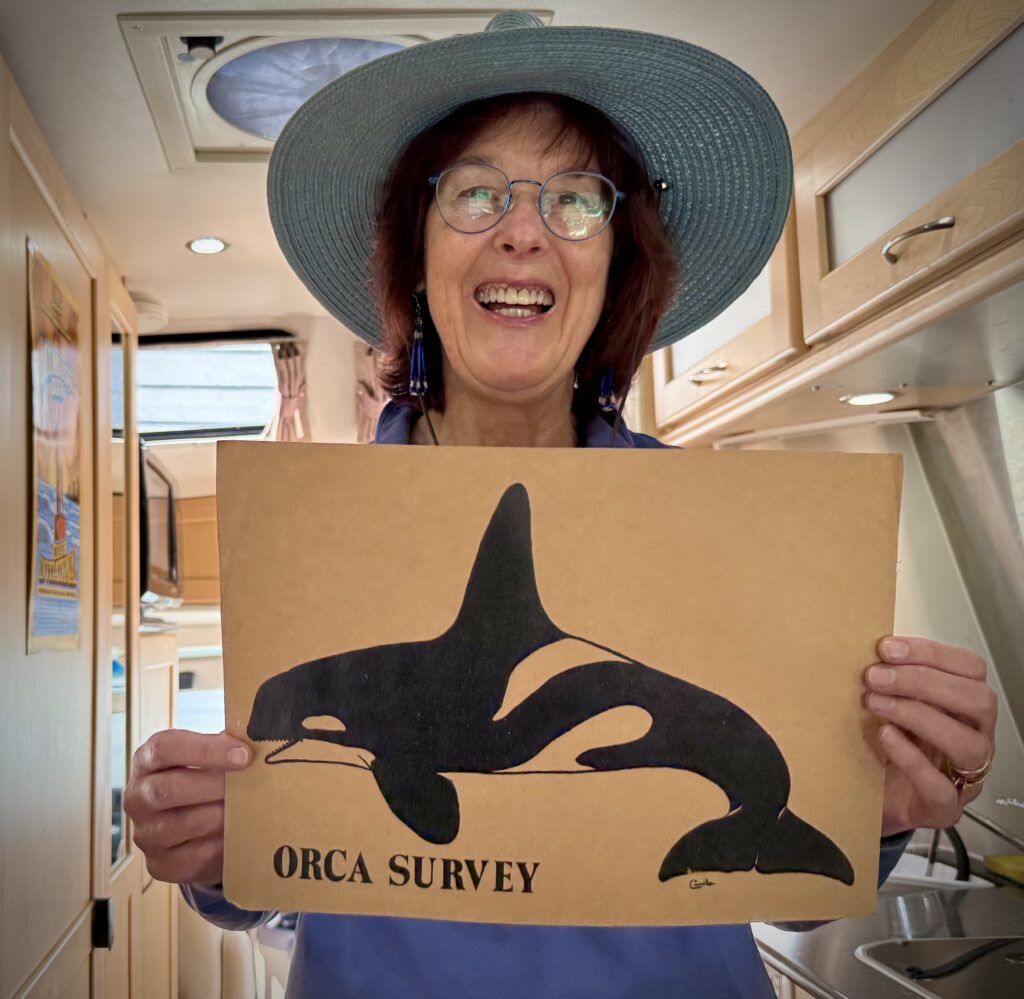
Orca Survey, which later became part of the Center for Whale Research, needed a logo to place on written materials, such as flyers and ID cards with photos of dorsal fins. People were urged to phone in when they spotted whales. Camille, who had studied art, designed the logo as a simple drawing of a killer whale, an image that was later used on flags, T-shirts and oval pin-on buttons to promote the research and raise money for the cause.
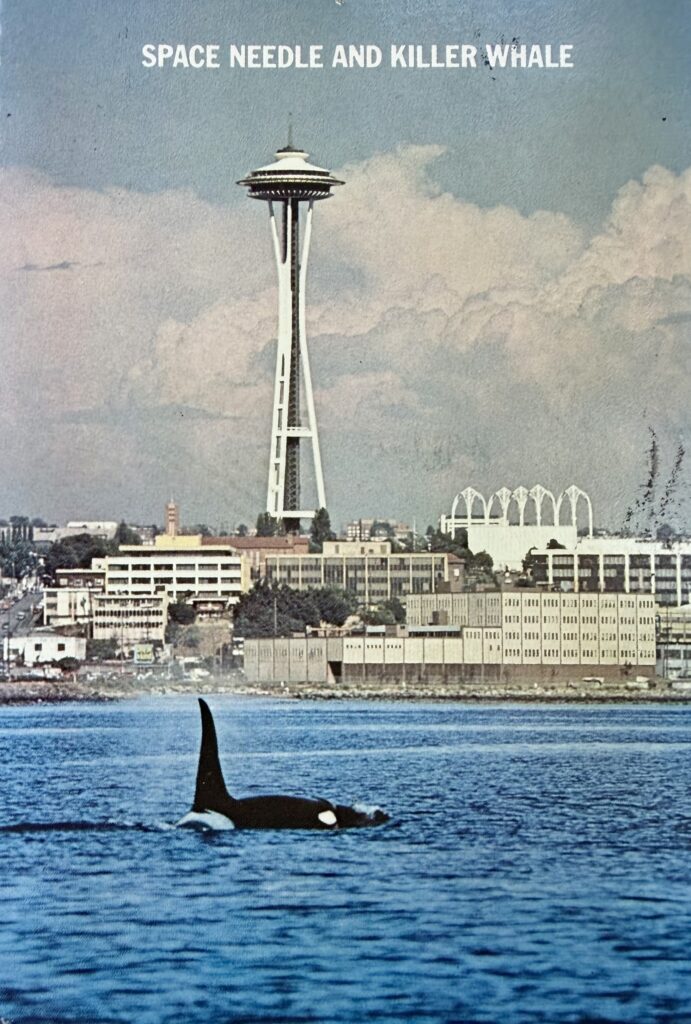
Ken Balcomb’s iconic photo of the whale J6 off the Seattle waterfront was taken in 1977 while Kelley drove the boat. The picture was turned into a postcard, which was sold and mailed to far-flung places by many whale lovers.
Kelley said he had a few favorite whales when he was a teen. One was L61, a male believed to be born in 1973 and later named Astral.
“He was a kid when I was young,” Kelley said. “Most of the babies were gone, because the capture years took the small ones. I was literally a teenager growing up with the whales.”
Another favorite was J18, born in 1978 and later named Everett. Kelley followed his development for 22 years.
“J18 was my boy,” Kelley said. “I was 15, and he was brand new. I loved this guy.”
J18’s mother was J10, named Tahoma. When she disappeared and was presumed dead in 1999, Kelley immediately feared for J18. He knew all too well that males, especially young ones, often die soon after their mothers are gone. In matriarchal societies, such as orcas, animals generally stay with their mothers and related clans for life. Kelley believed that J18 must be suffering from heartache after losing his mom.
A few months later, Kelley was at home on San Juan Island when a news story about a dead orca came on the television.
“The camera panned up from the tail, and I saw the saddle. I recognized J18, and I was crushed. I literally sat down and cried. It was like seeing your child in a car accident on TV. He was just 22 years old.”
Too many whales have gone missing through the years from the southern resident community. In the recent past, years of population decline have outpaced years of population growth. Every birth is a cause for celebration. Every death is a cause for mourning.
Ken is often quoted as saying, “I’m not going to count them to zero, at least not quietly,” as he became more outspoken in his later years.
Since its inception, the Orca Survey has followed the lives of 224 individual whales, according to a Facebook post by the Center for Whale Research, which was formed in 1984 and formally incorporated in 1986.
50-year survivors
Four whales listed in the 1976 census of southern residents are still alive. Their listed ages are based on estimates made during the early years of study, with some of the following descriptions from Orca Conservancy:
L25, “Ocean Sun,” is estimated at 98 years old. She is the only living survivor who was an adult during the Orca Survey’s first year, when she was estimated to be age 48. She is the presumed mother of L23, named Tsunami, who had two offspring, L14 “Cordy” and L49 “Tarazed,” all now deceased.
L22, “Spirit,” was estimated to be 5 years old during the first year of Orca Survey. She is believed to be the daughter of L32, “Olympia.” Spirit’s brother, L87, “Onyx,” was born in 1992 and is still alive. At least three other siblings have died. Spirit herself had three known calves, all now deceased.
K12, “Sequim,” was estimated to be 4 years old during the first year of Orca Survey. Her mother was K4, “Morgan.” Sequim has had five offspring, three of whom are still living: K22, “Sekiu,” a 39-year-old female who has a living offspring, K33, “Tika;” K37, “Rainshadow,” a 22-year-old female; and K43, “Saturna,” a 16-year-old female, who may be the mother of the new calf, K43.
J16, “Slick,” also was estimated to be 4 years old during the first year of the Orca Survey. The daughter of J7 or “Sucia,” Slick was first thought to be a male. She has had six offspring, making her one of the most productive females. Three are still living, J26, “Mike,” a 35-year-old male; J36, “Alki,” a 27-year-old female; and J42, “Echo,” a 19-year-old female.
Slick’s youngest, J50, a female named Scarlet, provoked an ongoing discussion, starting before her death in 2018, about whether humans should intervene to save an ailing killer whale, especially part of an endangered species. See Encyclopedia of Puget Sound.
Celebrations
The Center for Whale Research will hold a 50th anniversary celebration event on Sept. 17 at the Tyee Yacht Club in Seattle. The fundraising dinner and auction, titled “Generations of Discovery,” will celebrate 50 years of CWR’s Orca Survey. Supporters will share stories of the ground-breaking science and discuss the urgent challenges facing this critically endangered population.Tickets may be purchased online.
A more casual, outdoors event, will be held on-island Aug. 21 at the San Juan Island Brewery to thank the community for 50 years of support. This gathering will feature brief presentations by the research team, followed by a live band. A $35 fee covers pizza and two drinks. The event begins at 4 p.m. with music starting at 6 p.m. Tickets may be purchased online.
Related information
— Ken Balcomb narrates his notes and provides commentary about the first day of the Orca Survey, April 1, 1976, in this YouTube video from 2021.
— Mike Bigg describes his discovery of the unique markings used to identify individual killer whales and what he learned about these whales that visit the inland waters of Washington and British Columbia. This YouTube video clip was taken from the 1989 documentary “Island of Whales.”
— Read about my professional and personal interactions with Ken Balcomb through the years in a 2023 tribute posted on the Blog “Our Water Ways”: “Remembering Ken Balcomb and his extraordinary life with killer whales.”
— Current staff of the Center for Whale Research.